Author Archives: Gareth Negus

Burke & Hare

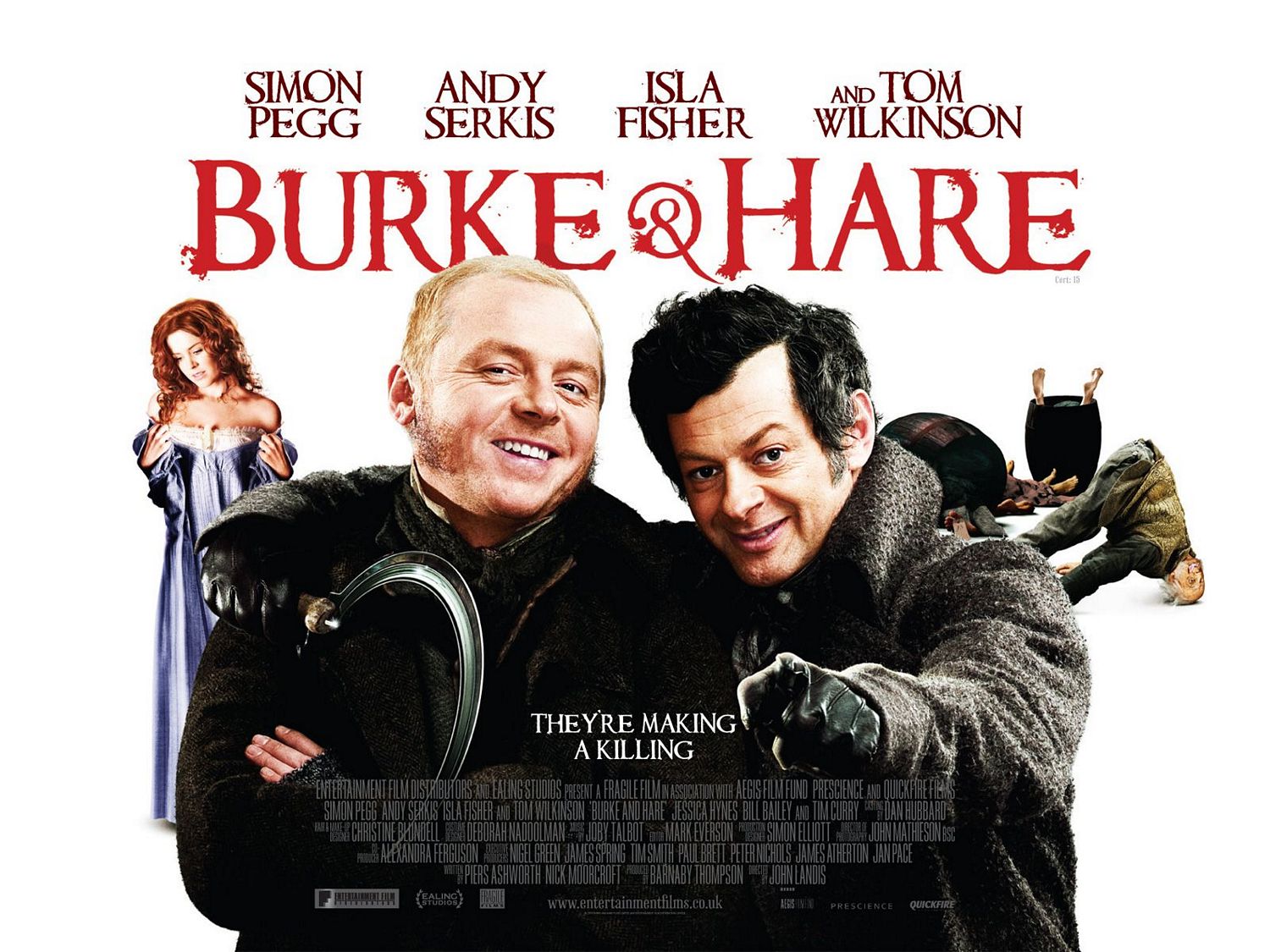
It starts with the Ealing Studios logo, but while this tale of a lovable pair of graverobbers turned killers shares the black comedy of many Ealing titles, the execution is more akin to a Carry On film.  We’re spared the constant double entendres, but do get a long line of cameos from familiar comedy faces (and Michael Winner), some of whom give fairly shonky performances.  The opening scene, with our lovable anti-heroes getting splattered with shit, doesn’t really tell the whole story but isn’t a great omen.
Simon Pegg and Andy Serkis star as a pair of Irish chancers trying to earn a dishonest crust in 1820s Edinburgh.  Rivalry between the head doctors at the city’s prominent medical teaching institutions creates a gap in the market for fresh bodies for dissection; a gap that Burke and Hare are quick to fill, first by taking advantage of a death by natural causes, then by more nefarious means. 
Some might question the taste of turning the story of a pair of murderous into a jolly romp.  Not me; I’m sick.  But there is a challenge in making the leads both plausible – they turn to crime due to desperate need for money, which is a reasonably current issue – while seeming like people you might like, in order for the audience to care what happens about them.  Both Pegg and director John Landis have form in mixing comedy with horror, in Shaun of the Dead and American Werewolf in London respectively.  Those films worked because the scripts were good, with characters you both believed in and liked; Shaun and his mates felt like people you might actually meet down the pub, as did the luckless hitchhikers of American Werewolf Burke & Hare doesn’t have such strong foundations; the thriller element doesn’t particularly excite, and the jokes just aren’t funny enough.  The audience I saw it with only managed a few chuckles.
Pegg and Serkis do what they can; Pegg does best with the more morally troubled but easily lead of the two, falling puppyishly in love with actress Isla Fisher.  Serkis has the more venal character to play, and works well with his screen wife (Jessica Hynes).
The rest of the cast varies considerably.  Tom Wilkinson brings his usual dignity, and a couple of American Werewolf cast members also pop up (I won’t spoil it by telling you who).  Against that, we have to suffer Ronnie Corbett, who destroys every scene he’s in as the leader of the militia hunting Burke and Hare.  Laboriously delivering every line as though still in a late 70s Two Ronnies sketch doesn’t count as acting, I’m afraid.
The film looks good (I’m a bit of a sucker for anything set in Edinburgh), doesn’t overstay its welcome, and is amiable enough.  However, I was hoping for a bit more.

Black Swan

By some measure the most intense 105 minutes I’ve spent in a cinema this year, Darren Aronofsky’s Black Swan is a melodramatic psychological horror that plunges the viewer into the disintegrating mind of a young woman. 

Natalie Portman stars as Nina, a driven ballerina whose major career break – the chance to perform the dual roles of the White and Black Swans in Swan Lake – places an intolerable strain on her psyche. 

Early on, the company director Thomas Leroy (Vincent Cassell) helpfully explains the plot of Swan Lake for us, dwelling on the conflict between the good White Swan and her evil lustful twin, the Black Swan.  Leroy has no doubt that Natalie is up to the role of the White Swan, but doubts she can embody the wilder, sensuous Black.  But he nevertheless decides to give her a chance at the role.  She continues to struggle: she constantly strives for perfection, but her idea of perfection is a purely technical one that doesn’t help her inhabit both roles.  Egged on by her controlling mother, whose own dance career was cut short when Nina was conceived, Nina clearly has long-term issues with self harm (she scratches herself obsessively, and it’s safe to add anorexia into the mix).  She also starts to feel increasingly threatened by Lily, a rival dancer who is… well, more of a Black Swan type.
The plot could have come from a 60s B movie; indeed, I couldn’t shake the idea that a version of the same script made 40 – 50 years earlier would have had Roger Corman and Vincent Price’s names in the credits (though whether Price would have been in the Cassell or Portman role is a question I couldn’t quite resolve).  But the execution is another matter.  I haven’t seen an Aronofsky film since Pi – not that I’ve particularly tried to avoid his stuff, it’s just sort of happened – so I can’t say if Black Swan is representative of his work (he states in the LFF catalogue that he sees it as a companion piece to The Wrestler, both films being about performers who use their bodies to express their souls).  It’s certainly not an easy watch.  Not only do we see the appalling punishment to which ballet dancers subject their feet (you want to beg them to take up a safer career, like maybe boxing, or juggling chainsaws while blindfold) but as Nina starts to hallucinate, various nasty things happen to nails in close up.  I haven’t had to look away from the screen so often since Saw III.
What the film does brilliantly is oblige us to share Nina’s increasingly shaky grip on reality.  It starts early on as Nina glimpses someone on the subway train who appears to be her double; we later discover that this is Lily, who gets off at the wrong stop on her way to her first rehearsal, but we – like Nina – are rattled already.  The doppelganger theme continues as Nina feels under attack variously from Lily – who may or may not be seeking to replace her – but from an apparently imaginary double.  It’s normally easy to spot which scenes in a film are real (in the context of the narrative) and which are fake.  It’s less so in this one. 

What really anchors the film is Natalie Portman as Nina; she is superb, and a sure bet for an Oscar nomination.  A less committed performance would have sunk the film, leaving us laughing as the plot, and the imagery, becomes ever more hysterical.  Portman is absolutely believable as the controlled, repressed, heartbreakingly fragile Nina.  Aronofsky’s visual and audio tricks take the film into the realm of madness; his star keeps it firmly believable.  

Black Swan is probably not for everyone, and may well be a love it or hate it film.  I thought it was amazing, and would absolutely urge anyone interested to see it in a cinema for the most immersive experience possible.

The American

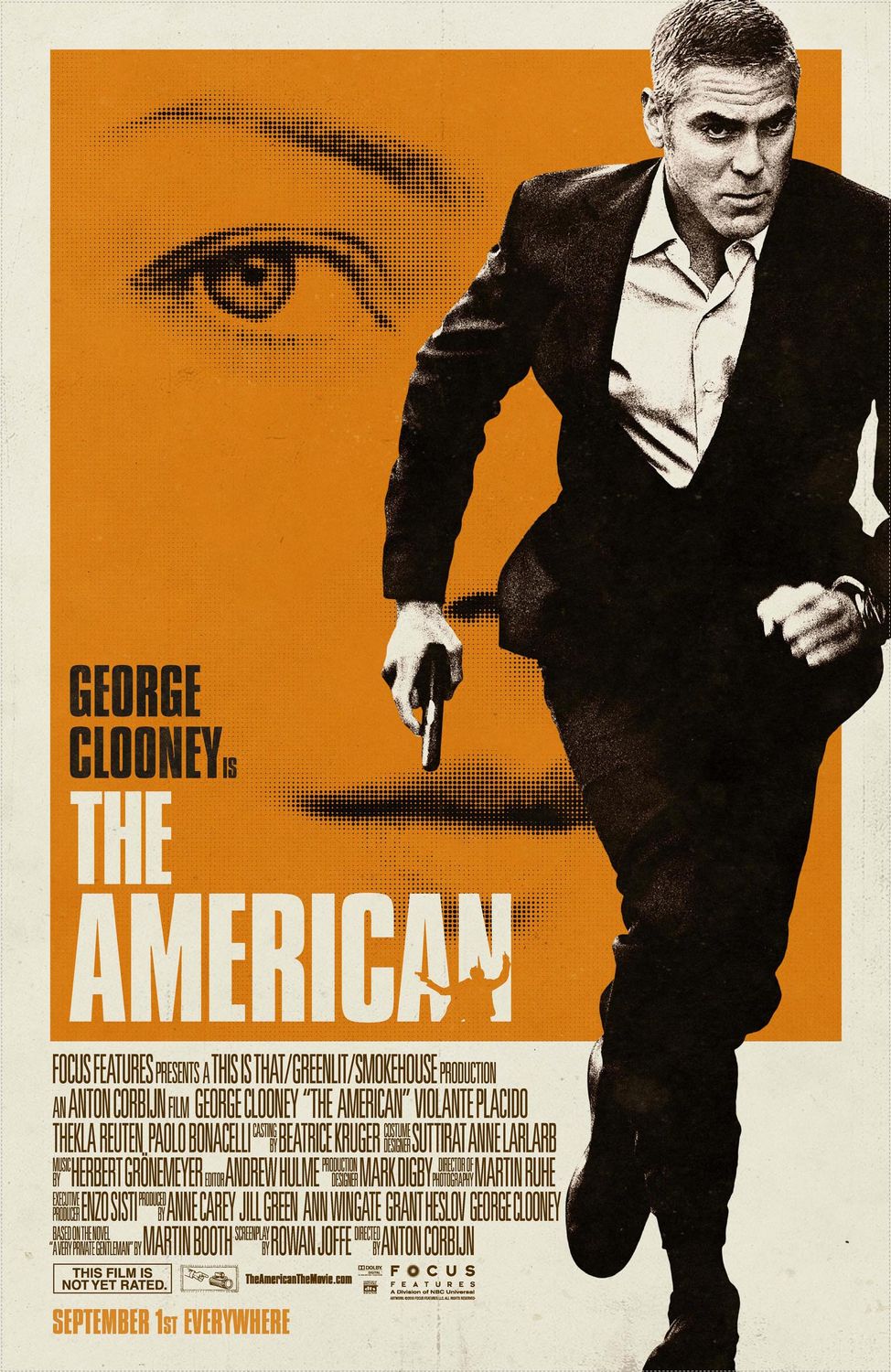
George Clooney as a hitman dodging bullets in picturesque Italian towns sounds like a winner.  However, Anton Corbijn’s follow up to Control takes a more existential route than the average moviegoer might wish.
Clooney stars as a butterfly loving assassin/gun supplier who, in the opening sequence, is targeted by couple of Swedes who have it in for him.  Following the ensuing carnage – which includes one jaw-dropping shock moment – he is sent by his boss to Italy to hide out.  Here, he hangs out in coffee bars, chats to a local priest, and contemplates the emptiness of his life while getting closer to a prostitute – despite having learned the hard way that friends are a bad idea in his game. 

The film looks good, with beautiful locations and a hot cast.  Emotionally, though, it’s cold.  The film is as taciturn as its lead character, aiming very much for an arthouse atmosphere, even in the action scenes.  It would not have been a surprise to see the director’s credit reading, ‘Steven Soderbergh, after Antonini’.  I was also reminded of Asif Kapadia’s The Warrior, another arthouse flick dressed up – possibly by the marketers rather than the makers – to look like an action thriller.
There’s plenty to admire here, but the general public may feel the film has been missold.  

Let Me In

We already have one adaptation of John Ajvide Lindqvist’s novel Let the Right One In, and those who have seen it generally agree it’s a pretty good one.  However, it has the bad luck not to be in English, so here comes Hollywood to provide us with a dumber remake.
Except it’s not dumb.  It’s a very impressive film that manages to be loyal to both the source novel and the film, while adding a few extra shades of its own. 
It’s interesting to see that this is the first cinema release from the freshly revived Hammer Films (they also have a new logo that uses old poster artwork, in a manner reminiscent of the Marvel Studios one).  Hammer weren’t shy of remakes and adaptations in their golden years, though then the choices were usually familiar literary properties like Dracula and Frankenstein (OK, and On the Buses) rather than a recent arthouse hit.  But they’ve made a wise move in looking beyond their back catalogue. 
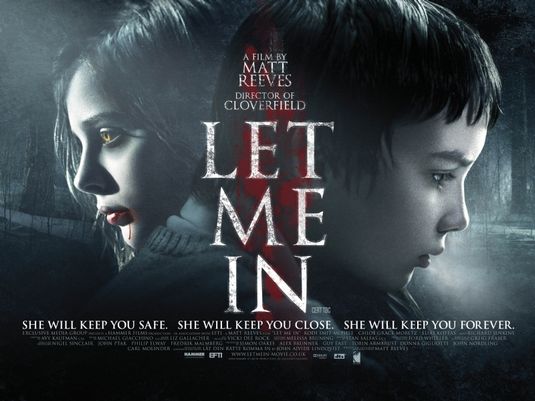
Lonely, bullied 12 year old Oscar seems to have made a new friend when a girl calls Abby moves in next door with a man who he assumes to be her father.  But after a murder or two, Oscar comes to realise that Abby is not actually 12 – or rather, has been 12 for a very long time – and needs a fresh supply of blood to live. 
Matt Reeve’s film has the taste to stay faithful to the visual and narrative style of Tomas Alfredson’s Swedish version; as with Gore Verbinski’s similarly close remake of The Ring, some shots are almost identical.  He has also cast two excellent young actors, Kodi Smit-McPhee and Chloe Moretz in the lead roles, with the slightly more experienced Richard Jenkins providing support (his scenes with Moretz are tender and disturbing at the same time).  As with The Ring, though, we do have to tolerate a few shots done up with unnecessary effects; Abby’s vampire attacks are sped up and enhanced with CGI, and look cartoony rather than horrific.  (She also leaps on one victim in view of a witness who she must have been able to spot, which is a bit of a strange decision).  But on the other hand, we lose the cat attack scene that was the original’s least convincing moment. 
There are other changes, inevitably.  The question about Abby/Eli’s gender has been given the chop (so to speak…) – not a loss newcomers would notice, though it does mean Abby’s question, “Would you like me if I wasn’t a girl”, loses a layer of meaning.  But the biggest change comes in one small scene where Oscar finds photos of Abby with a young Father.  A tiny moment, but it radically alters the Father’s character and, by implication, Abby’s.  The Swedish film is not explicit, but my reading was that the ‘father’, Hakan, was a paedophile recruited by Eli to hunt for her and provide protection (this was confirmed by the novel, which I read subsequently).  Making him a childhood friend of Abby’s suggests she may be consciously grooming Oscar as a replacement.  I can’t see much sign of this in Moretz’s performance – she seems to be playing the character as written in the original version – so I’d be interested to know why Reeves made this change, and if he discussed its implication with his actors.  It actually makes the ending of the film far bleaker than that of the original. 
Let Me In may not escape the long shadow cast by its predecessors, but it is nevertheless the best kind of remake: one which stays respectful to the source material while standing firmly on its own.

Never Let Me Go

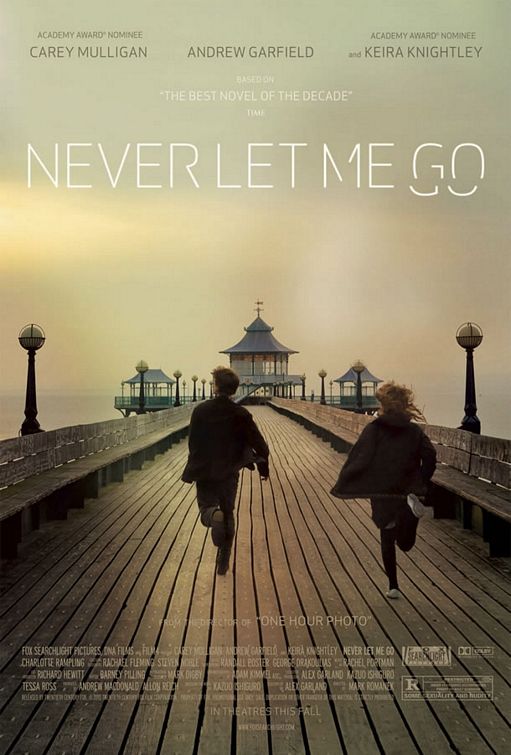
The opening film of this year’s London Film Festival is an adaptation of Kazuo Ishiguro’s SF-tinged novel, directed by Mark Romanek and starring Carey Mulligan, Andrew Garfield and Keira Knightley as Kathy, Tommy and Ruth.  Growing up together in a slightly odd boarding school – initially played by three child actors who look uncannily like their older counterparts, so much so that you half suspect Mulligan has been somehow digitally made younger – the threesome become entwined in a love triangle that plays out against the discovery of their true purpose in life.

The film suffers from the same problem as many literary adaptations: the use of voiceover to fill in chunks of plot.  I don’t doubt that this works in the novel, but with Kathy effectively telling the whole story in flashback, the viewer is immediately at one remove from the events on screen: it gets in the way of emotional involvement.
But that’s a relatively minor problem.  The big one is that at no point was I convinced by the world portrayed in the film.  It’s set in a kind of dystopian alternative England with one foot still in the 1950s, where the use of cloned human beings for enforced organ donation is a fact of everyday life.  How the hell does that work?  We live in a society where the use of stem cells in cancer research is controversial, where abortion stirs passionate debate, where animal rights activists will adopt techniques usually associated with terrorist groups.  Are we really supposed to believe that the general public blithely accept the use of human clones as body banks?  They are out in the community, to some extent: certainly, the hospital staff all seem aware of what’s happening.  Does nobody try to help these people?  Do none of them try to escape?
Other questions I found myself asking: are these organ donations available to all and sundry, or only the wealthy and privileged?  The former would presumably lead to a rise in the number of centenarians, so what’s that done to the pensions crisis?  And if it’s the latter, if the bulk of the country can’t benefit from these medical advances, they’re surely more likely to indulge in moral qualms about what’s being done to the clones. 

If I’m being bothered by questions like these while I’m watching the film, then I tend to think something’s wrong.  I’m told by those who have read it that such issues aren’t a problem when reading the book, so maybe Ishiguro makes it work in print in a way that it doesn’t on screen.  As it is, the film has to be regarded as a metaphor, with the central trio standing in for whichever exploited group you prefer: slaves, battery hens, take your pick.  This is a valid approach, and could allow the film to raise questions about the extent to which any of us are controlled and have our freedoms restricted by the state (Kathy’s final voiceover does just this, but too late).  But I think screenwriter Alex Garland tried to make the film work as a convincing portrayal of a fascist – or arguably fascist – state, and it doesn’t.
But if the film is hollow at the core, it does benefit from some terrific work by the cast, notably Mulligan and Garfield.  It’s thanks to their work that the ending does pack a substantial emotional punch.  But it should have been much more powerful; the knowledge of the full evil to which these innocents have been subjected should leave you utterly crushed.  It doesn’t.  

In the end, this is a superbly played, good looking and generally well mounted film that is, sadly, a little inert.

The Social Network

The creation of the Facebook website did not sound, when I first heard about it, like a particularly gripping subject for a movie.  But while the technical details may not enthrall, the story of jealousy and betrayal that lies behind it does.  
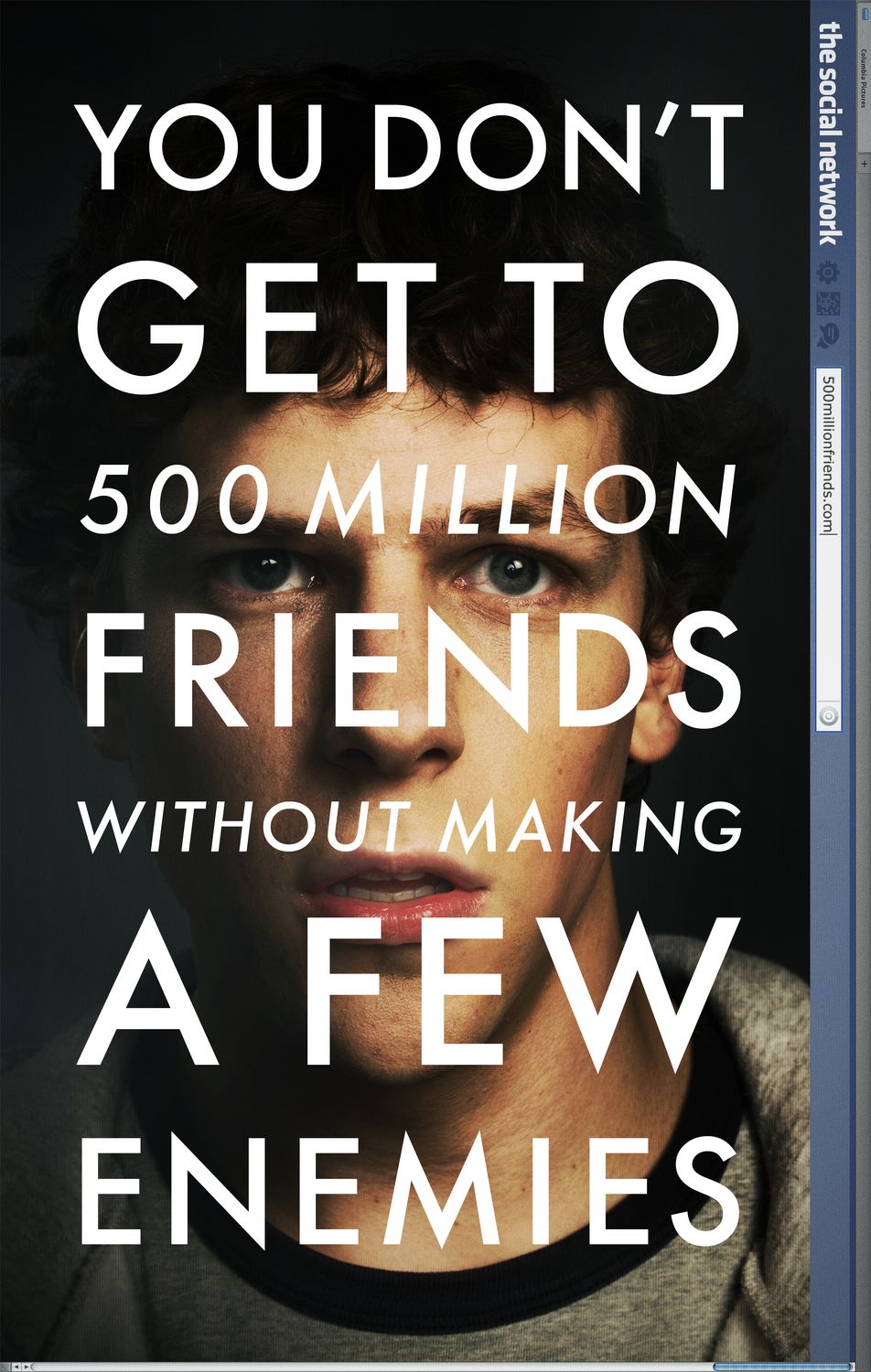
Jesse Eisenberg stars as Dr Sheldon Cooper… oops, I mean Mark Zuckerberg.  In the opening scene, he is dumped by his girlfriend Erica (Rooney Mara) for a combination of arrogance, ambition, and a complete inability to understand why she’s annoyed with him.  It sets up the film’s central irony – that a man with so little in the way of social skills managed to create the world’s biggest social networking site, before finding himself being sued by his one close friend.  That’s Eduardo Saverin (Andrew Garfield), who put up the initial funding for the site and helped write the initial code but ultimately found himself squeezed out.
The Social Network is credited as a David Fincher film; but when watching, it feels far more like an Aaron Sorkin film.  That’s not to take anything away from Fincher’s work, only to acknowledge that Sorkin’s authorial hand can be sensed throughout.  In The West Wing, he showed himself to be one of the few TV writer/producers with a distinctive, even unmistakable dialogue style.  There, his favourite trick was to have characters talking about political matters very quickly, intensely and often wittily in order to avoid boring viewers; here, algorithms and coding are debated in the same manner.  I don’t really understand what algorithms are (and when I say “not really” I mean “not at all”) and when people in the film don’t answer others because they’re coding, you might just as well tell me they’re communing with the matrix for all the sense it makes to me.  But it sounds dramatic.  Earlier in the day I’d seen Wall Street: Money Never Sleeps, which fails utterly to pull off the same trick; whenever the characters started talking about sub-prime, my eyes started to glaze over and I began to ponder more important questions, like what I might have for tea.
As played by Eisenberg, Zuckerberg is something of an enigma. He is variously accused of being an asshole, and of trying to be an asshole; it’s left to the viewer to judge which verdict is closer to the truth. His failure to empathise with others reaches almost levels that appear almost autistic; he is consistently rude and condescending to authority figures; yet he appears to regret the loss of his friendship with Saverin, while it’s suggested that much of his motivation came from a desire to disprove Erica’s assessment of him.  Indeed, many of the characters go round with sizable chips on their shoulders, stemming from their ethnicity, class or perceived (by themselves or others) social status.  Whether these grudges really were behind the multi-million dollar rise of facebook and the subsequent lawsuits, or whether they are dramatic conceits of Sorkin and/or Ben Mezrich (who wrote the book The Accidental Millionaires, on which the screenplay is based) I can only guess.  But I would love to know, just as I would love to know Zuckerberg’s honest opinion of the film. 
The film is performed superbly by Eisenberg, Mara (who thankfully shows there’s more to her than dodgy 80s horror rehashes, and bodes well for her upcoming role in the Girl with the Dragon Tattoo remake) and Justin Timberlake, as the unpredictable Napster founder Sean Parker.  Garfield, though excellent as Saverin, does seem a bit too good looking and charismatic to play a nerd who supposedly has trouble getting girls.  Still, that’s Hollywood.  This is definitely one to like.

The Hole

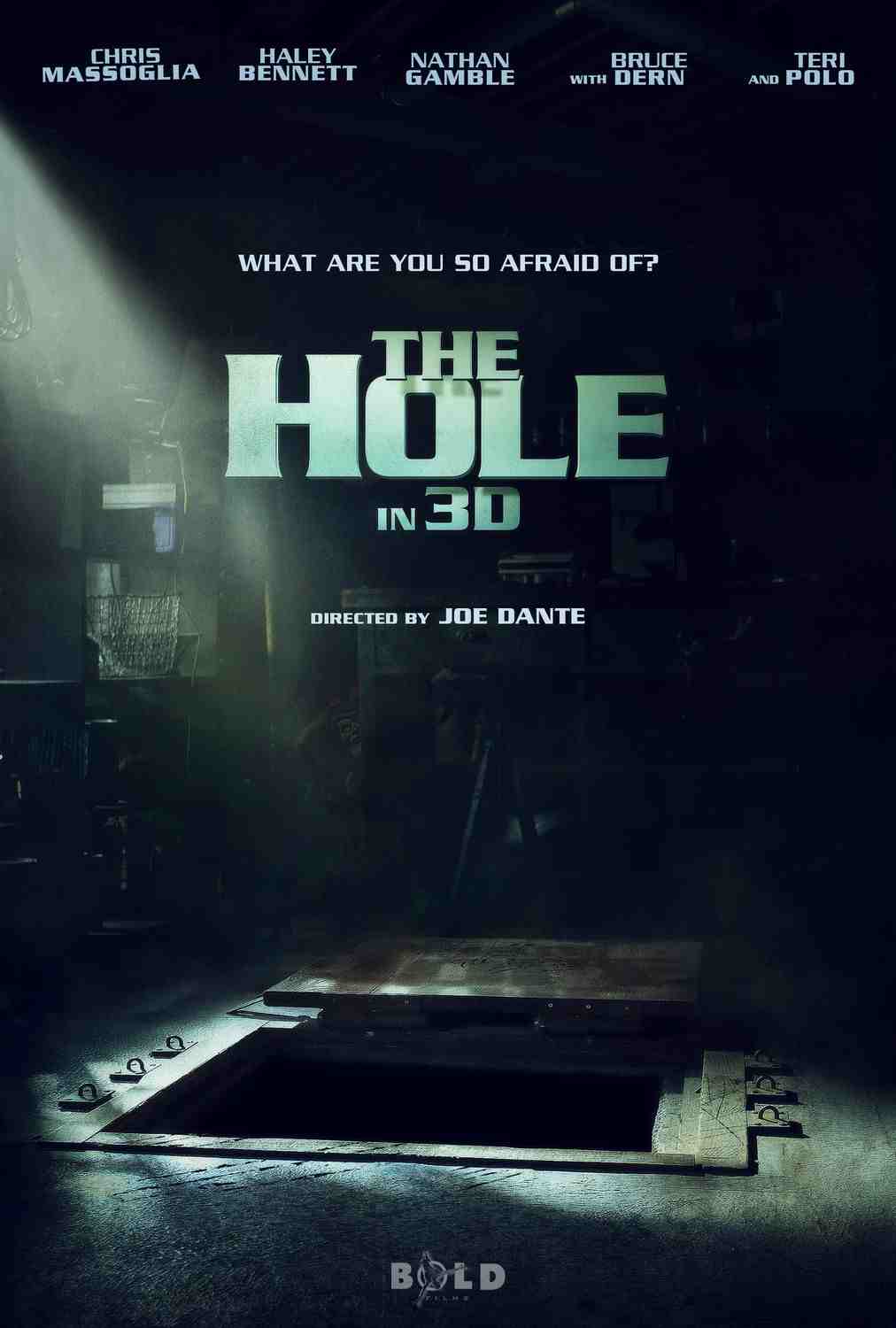
Here’s something I’ve been anticipating ever since seeing director Joe Dante’s talk at the Edinburgh Film Festival last year (I got my photo taken with him afterwards). The Hole is a pleasingly old fashioned horror(ish) film for kids – and by old fashioned, I mean it’s reminiscent of 80s favourites like Dante’s own Gremlins, Fred Dekker’s The Monster Squad and the TV series Eerie, Indiana. There’s even a Dick Miller cameo.

Dane (Chris Massoglia), his mom and his kid brother (Nathan Gamble) move into a new suburban home, where the kids – along with Julie (Hayley Bennett), the hot girl next door – find a mysterious, heavily padlocked trap door in the basement. Naturally, they open it, to find an apparently bottomless hole. It seems to be empty, but before long some of their greatest fears are getting out, and are coming to get them…

The scares are strictly 12A-level. There’s a fair bit of creepy atmosphere-building at first, as odd things start to happen; though only those who share Lucas’s fear of clowns will be disturbed by his scenes, we also get a little ghost girl as disturbing as anything from the J-horror pantheon. (It’s very hard for a scary film to go wrong with little dead girls in my book.) Dane’s nightmare (of his violent father, currently in prison) is a little underwhelming by comparison, and leads to the climax being the film’s weak point. That’s unavoidable, given the film’s message about facing your fears – the threat is inevitably less scary once you look it in the eye than when it’s lurking in the dark. So although Hayley theorises that it’s a bottomless pit to Hell (quite correctly adding, “and that’s really cool,”), The Hole doesn’t go anywhere as nasty as that. I wouldn’t have minded a few more shocks, but that’s being selfish – I certainly wouldn’t wish to keep this film from the young audience it’s aimed at.

Dante also enjoys himself with the 3D, and wants to make sure the audience does too. A fan of the format from way back when, he has no qualms about throwing in every attention-grabbing coming-out-of-the-screen moment he can come up with. The plot lends itself easily to plenty of shots of people looking into, and dropping stuff into, the bottomless pit; rather charmingly, there’s even a shot of a kid on the bed, repeatedly tossing a baseball up toward the camera. It’s like Friday the 13th part III hadn’t happened. While the best bits will hold up fine in 2D, this is a pleasing example of form and content complementing each other.

I hope there’s space in cinemas for The Hole to settle, between the likes of Despicable Me and tween stuff like Twilight. It’s a well-crafted crowdpleaser which will entertain anyone with fond memories of the 80s fantasy/adventure films that generally had Dante and/or Steven Spielberg’s names on. And, if they’ve any taste, it’ll please their kids as well.

Tamara Drewe

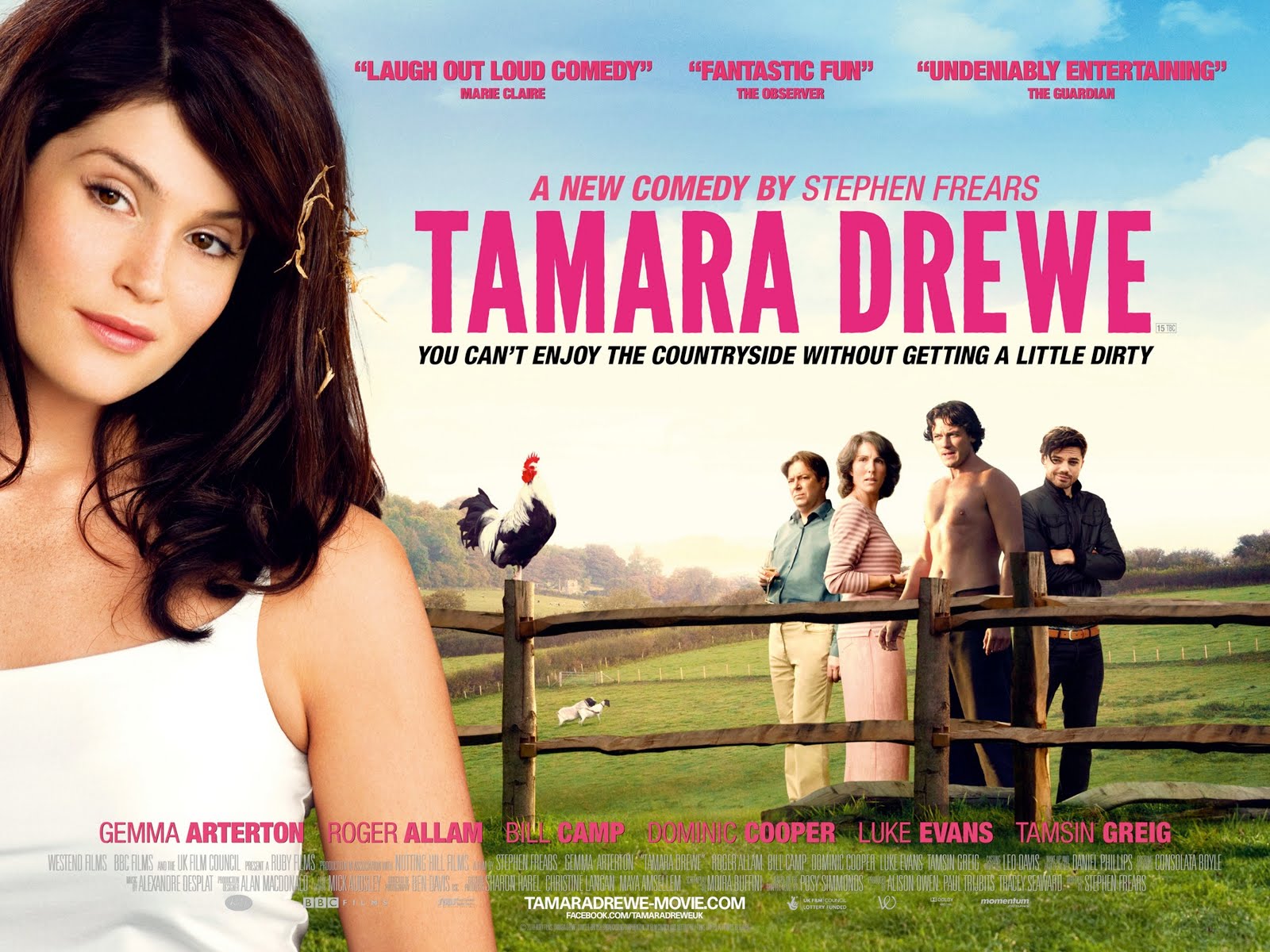
Someone seems to have been on autopilot throughout the making of this adaptation of Posy Simmond’s graphic novel take on Far From the Madding Crowd… and we have to assume that someone is director Stephen Frears.  Scene follows scene in a leisurely manner, without any kind of drive or pace developing.  Small wonder the local kids moan that nothing ever happens in their village – despite the incidents in the plot, that’s very much how it feels to the viewer.
It’s not the fault of the cast, who all seem to be putting the effort in.  Standouts are Tamsin Greig as Beth, long-suffering wife of philandering author Nicholas Hardiman (Roger Allam), while Jessica Barden and Charlotte Christie as meddling teens Jody and Casey give zestful performances.
Dominic Cooper, on the other hand, can’t make his cartoony rock star seem anything like a real person, and unfortunately nor can Gemma Arterton in the title role.  Tamara Drewe is something of a blank; we really only see her through the (mostly lustful) eyes of others, and consequently don’t get to know her.  The script tells us bits about her history, but these glimpses never add up to a full person.  It might have helped if we got to hear more of her own writing – everyone in the film is presumably familiar with her column – but the film doesn’t share her inner voice with us.  Maybe this is deliberate – I seem to remember feeling the same way about her character in the book, which I haven’t read since its original serialisation in The Guardian – but if so, I’m not convinced everyone involved in the making of the film was aware of it.
Not an unwatchable film, then (and unlike Frears’ last, Cheri, I at least stayed awake) but for a film ostensibly about lust and desire, it’s an oddly passionless affair.

Hollywood Endings

Alexandre Aja’s remake of Piranha is, for the most part, tremendous trashy fun. It has no pretensions to be anything other than an unashamed B-movie, with plenty of gratuitous gore and even more gratuitous nudity. I sometimes get depressed by nudity in films – it too often feels like a sop to a perceived audience of teenage boys who don’t get to see the real thing yet, and I feel bad for the actress whose only role in the film is to get her tits out and then get killed. But the nudity in Piranha is so frequent and blatant, so completely over the top that it punches through the barrier of offensiveness to be become almost innocent fun. There are so many breasts on view that after a while you stop noticing them.

But there’s one thing that let the film down for me, and that’s the ending. (Warning: spoilers for Piranha, and several other films, follow.)

Piranha follows what seems to be an increasing number of films in not having a proper ending: it just stops in what is, to all intents and purposes, the middle of a scene. The strategy is to make the audience think the film is over, and the threat has passed, only to pull the rug suddenly out from under them before the end credits crash in. In this case, just as we think our heroes have escaped being eaten by the piranhas, the Basil Exposition character (Christopher Lloyd) rings up to say they were in fact only babies. On cue, a giant – almost mega – adult piranha leaps from the water and swallows the male lead. End of film.

Obviously, twist endings aren’t new. Nor is the habit of horror movies suggesting that the evil has only temporarily been vanquished and will rise again at some indeterminate point in the future – whether that’s revealed by a shot of another baby alligator being flushed into the sewers, or a shot of Freddy Kreuger apparently reflected in a fountain. That’s fine. But with Piranha, we’re left asking – is that the only adult fish? Are all the other characters about to be eaten? Will that include the two children?

This, to my mind, is just bad storytelling; a cheap and lazy trick to play on the audience. It’s not that I object to downbeat endings. Although it’s true that as I get older and more sentimental I prefer at least a ray of hope at the end of a horror movie, sometimes an unhappy ending feels right. Take The Descent, which (at least in the UK) ends with the heroine alone in the caves, lost and apparently mad, as the monsters close in. This felt like the ending to which the film had been building all along; it played fair with the audience. (Shame they couldn’t stick to it; it would have spared us the redundant sequel.) Similarly, the Saw films regularly conclude with a doomed character realising, too late, all the ways they could have avoided becoming one of Jigsaw’s victims.

Piranha’s approach follows any number of other films: the first Friday the 13th, the original Nightmare on Elm Street (a film which famously struggled to get its ending right, and didn’t succeed). Brian de Palma’s Carrie has one of the most famous shock endings, though this is at least revealed to be a dream sequence.

The recent wave of 70s remakes seemingly delight in following the same pattern, so faithfully that you wonder if idiot producers have come to believe it’s a necessary part of the formula. The Hills Have Eyes (also the work of Aja) pulls back to reveal the surviving family members being watched by another mutant, suggesting that their fight isn’t over yet. The recent version of The Crazies pulls pretty much the same trick, though this one asks us to believe the US government is now planning to wipe out an entire city and try to cover it up; I don’t see them pulling that one off. Zack Snyder’s Dawn of the Dead at least has the hope-crushing scenes play out under the end credits, which feels more honest that the “Ha ha! Gotcha!” approach of Piranha.

The Final Destination films love doing this, and one of the reasons that the second is my favourite of the series is that you can still read the ending as having the two lead characters survive. The two following films don’t even bother to pretend there’s any chance of the characters making it to the end, which severely lessens the suspense, and therefore the fun, of the film. The most recent, The Final Destination, is so uninterested in its characters that we learn virtually nothing about them – are they still in High School? College? Gainful careers? Do they have families? Who cares, they’ll all be dead meat in 85 minutes.

Ultimately, this kind of approach cheapens the film. If you want audiences to become involved in your story, however hackneyed it is, they have to care about at least some of the characters and want them to survive. Even a movie like Piranha, which is silly and shallow (that’s not a criticism in context), should take you on an emotional journey with the hero and/or heroine. The audience should feel a degree of empathy. To have that snatched away for the sake of cheap jolt makes a joke of that involvement, as though the filmmakers are mocking you for giving a shit. Hollywood: please stop doing it.

Scott Pilgrim vs the World

Most comic book adaptations require the viewer to buy into a fantasy world. Edgar Wright’s Scott Pilgrim vs the World asks us to accept two. First, there’s the cooler-than-cool muso slacker lifestyle of Scott and his friends – OK, maybe not technically a fantasy in the usual sense of the word, though from where I’m sitting it might as well be. Then there’s the way the story is told through a series of OTT fights, fantasy scenes and magic realism, as Scott faces various romantic challenges as though they were levels of a video game.

If you aren’t willing to accept either level of fantasy, then Scott Pilgrim will be something of a chore. If you can, it’s great fun.

Scott Pilgrim shares a flat with his gay friend Wallace Wells, plays in a band called Sex Bob-omb, and is still only just recovering from a traumatic dumping a year previously. Then he meets Ramona Flowers (Mary Elizabeth Winstead) the girl of his dreams (literally; he’s already dreamt about her, thanks to Ramona taking a handy short cut through his head). Just as their relationship is starting to blossom, Scott learns that Ramona has some major baggage in the form of 7 evil exes, who Scott must fight and defeat in order to win her hand.

I wasn’t sure about Michael Cera as Scott at first. We’re told that he’s really cool and awesome, but as Cera plays him as nervy and uncertain as every other character he’s played, it’s hard to judge if we’re meant to take this seriously. His portrayal works better once Ramona enters the picture and we see Scott desperate to impress her. Other cast members hit the right note of droll irony and/or broad comedy as required. Favourites include Chris Evans as a star of knucklehead Hollywood action movies, Kieran Culkin (who seems to be turning into Alan Tudyk, rather surprisingly) as Wallace and Alison Pill as Sex Bob-omb drummer Kim Pine, who looks as though she was drawn by a comic book artist.

The fact that a new partner may have weightier baggage than initially apparent is something most people would be able to relate to and you could, if you wished, see the fantasy battles of the film as metaphors: Scott’s image of his struggle to live up to Ramona’s memory of her former partners, filtered through his reference points of video games and music. But that would mean accepting the whole film as being told by someone who could be a very unreliable narrator indeed, so it’s probably best to just relax and enjoy the visual overload. The laughs started early at the screening I attended, with the videogame style rendering of the universal logo; other crowd pleasers included the explanation for Evil Ex Brandon Routh’s superpowers.

Scott Pilgrim is certainly not the most emotionally satisfying film about fighting for your one true love (I didn’t much care which girl Scott ended up with, if any) but it’s a fun, lively and entertaining couple of hours.