Category Archives: Reviews

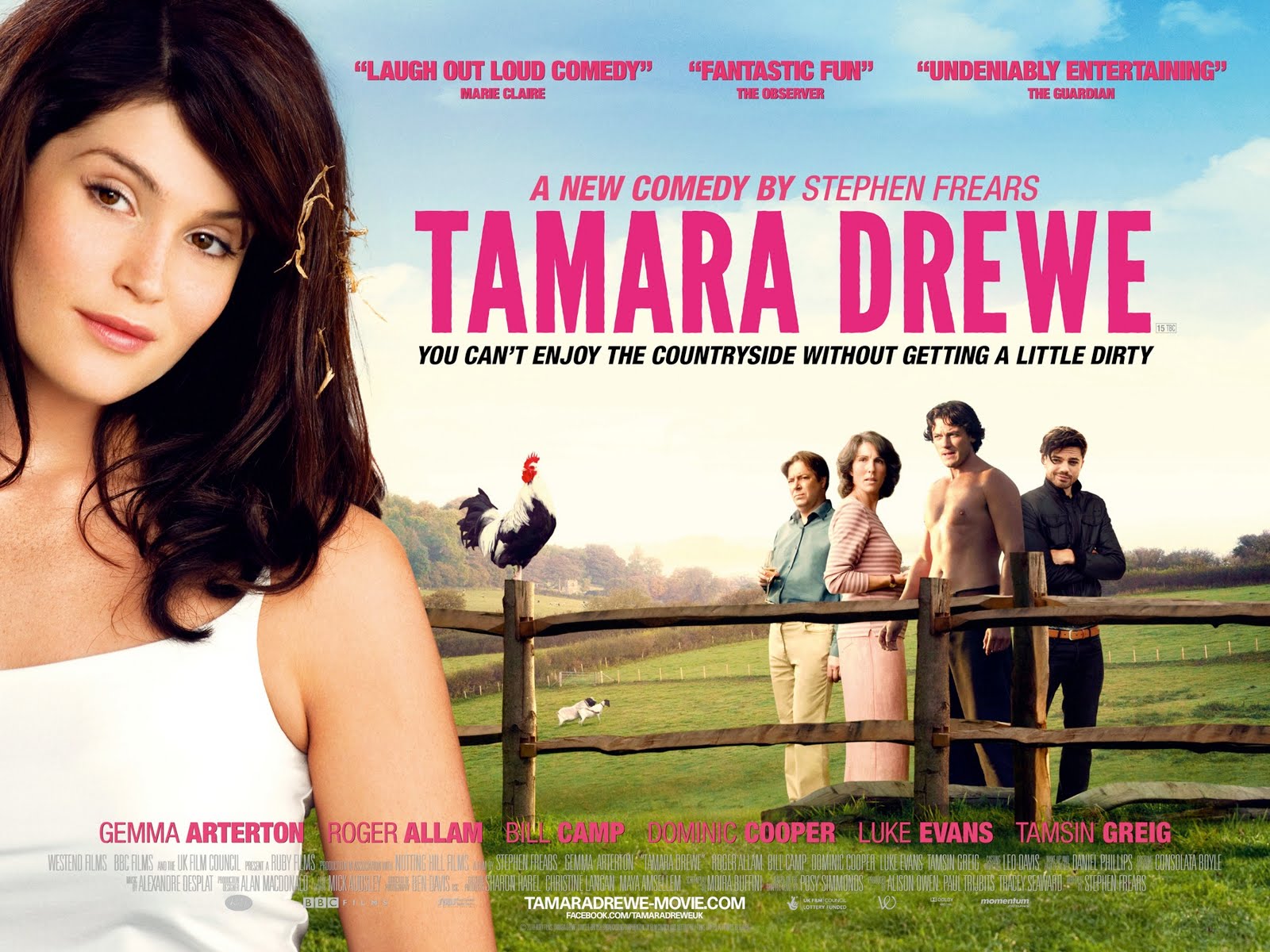
Tamara Drewe

Someone seems to have been on autopilot throughout the making of this adaptation of Posy Simmond’s graphic novel take on Far From the Madding Crowd… and we have to assume that someone is director Stephen Frears.  Scene follows scene in a leisurely manner, without any kind of drive or pace developing.  Small wonder the local kids moan that nothing ever happens in their village – despite the incidents in the plot, that’s very much how it feels to the viewer.
It’s not the fault of the cast, who all seem to be putting the effort in.  Standouts are Tamsin Greig as Beth, long-suffering wife of philandering author Nicholas Hardiman (Roger Allam), while Jessica Barden and Charlotte Christie as meddling teens Jody and Casey give zestful performances.
Dominic Cooper, on the other hand, can’t make his cartoony rock star seem anything like a real person, and unfortunately nor can Gemma Arterton in the title role.  Tamara Drewe is something of a blank; we really only see her through the (mostly lustful) eyes of others, and consequently don’t get to know her.  The script tells us bits about her history, but these glimpses never add up to a full person.  It might have helped if we got to hear more of her own writing – everyone in the film is presumably familiar with her column – but the film doesn’t share her inner voice with us.  Maybe this is deliberate – I seem to remember feeling the same way about her character in the book, which I haven’t read since its original serialisation in The Guardian – but if so, I’m not convinced everyone involved in the making of the film was aware of it.
Not an unwatchable film, then (and unlike Frears’ last, Cheri, I at least stayed awake) but for a film ostensibly about lust and desire, it’s an oddly passionless affair.

Scott Pilgrim vs the World

Most comic book adaptations require the viewer to buy into a fantasy world. Edgar Wright’s Scott Pilgrim vs the World asks us to accept two. First, there’s the cooler-than-cool muso slacker lifestyle of Scott and his friends – OK, maybe not technically a fantasy in the usual sense of the word, though from where I’m sitting it might as well be. Then there’s the way the story is told through a series of OTT fights, fantasy scenes and magic realism, as Scott faces various romantic challenges as though they were levels of a video game.

If you aren’t willing to accept either level of fantasy, then Scott Pilgrim will be something of a chore. If you can, it’s great fun.

Scott Pilgrim shares a flat with his gay friend Wallace Wells, plays in a band called Sex Bob-omb, and is still only just recovering from a traumatic dumping a year previously. Then he meets Ramona Flowers (Mary Elizabeth Winstead) the girl of his dreams (literally; he’s already dreamt about her, thanks to Ramona taking a handy short cut through his head). Just as their relationship is starting to blossom, Scott learns that Ramona has some major baggage in the form of 7 evil exes, who Scott must fight and defeat in order to win her hand.

I wasn’t sure about Michael Cera as Scott at first. We’re told that he’s really cool and awesome, but as Cera plays him as nervy and uncertain as every other character he’s played, it’s hard to judge if we’re meant to take this seriously. His portrayal works better once Ramona enters the picture and we see Scott desperate to impress her. Other cast members hit the right note of droll irony and/or broad comedy as required. Favourites include Chris Evans as a star of knucklehead Hollywood action movies, Kieran Culkin (who seems to be turning into Alan Tudyk, rather surprisingly) as Wallace and Alison Pill as Sex Bob-omb drummer Kim Pine, who looks as though she was drawn by a comic book artist.

The fact that a new partner may have weightier baggage than initially apparent is something most people would be able to relate to and you could, if you wished, see the fantasy battles of the film as metaphors: Scott’s image of his struggle to live up to Ramona’s memory of her former partners, filtered through his reference points of video games and music. But that would mean accepting the whole film as being told by someone who could be a very unreliable narrator indeed, so it’s probably best to just relax and enjoy the visual overload. The laughs started early at the screening I attended, with the videogame style rendering of the universal logo; other crowd pleasers included the explanation for Evil Ex Brandon Routh’s superpowers.

Scott Pilgrim is certainly not the most emotionally satisfying film about fighting for your one true love (I didn’t much care which girl Scott ended up with, if any) but it’s a fun, lively and entertaining couple of hours.

Baaria


Giuseppe Tornatore’s Baaria is the story of the titular Italian town, through the eyes of community party activist Peppino (Francesco Scianna). It takes us from his pre-war childhood to the moment, around half a century later, when his son leaves home to make his own way in the world.

That’s a lot for one film to cover, even a very long film like this, and it’s not a great success. A succession of often disconnected scenes and incidents take us through the decades, but feel largely isolated from those around them. The effect is to reduce the likelihood of becoming emotionally involved with any of the characters.

Worse, the whole film is unashamedly nostalgic – even political corruption and mafia violence is seen through the glow of rose-tinted spectacles, and lovingly coated with Ennio Morricone’s strings. The fact that the narrative doesn’t take us up to the present day (not that I’m asking for another half hour…) implies these are problems that belong in Italy’s past.

Watch any half hour of Baaria and you’ll get a generous handful of scenes and sketches, any of which are perfectly watchable on their own merits, along with some lovely images of Italian countryside. Sadly, all these moments combined add up to little more than two and a half hours that you’ll never get back.

The Karate Kid


Hollywood will remake anything that has a recognisable title, be it a book, a TV show or a movie – ideally one that people who liked the original will now take their kids to. Hence the new version of The Karate Kid – which doesn’t have any karate in it, though the more honest title of The King Fu Kid was presumably passed for lacking the necessary brand recognition. Still, at least this time he is an actual kid rather than a twentysomething faking it.
It also has an advantage in that the original film is not exactly a deathless classic (I expect – I haven’t seen it, though I did see the sequel), which leads to safely lowered expectations. Luckily, the new version is a very watchable film.
Jaden Smith, who seems to have inherited his dad’s charm, plays 12-year-old Dre, who is obliged to move to China with his mom. Soon he is having his ass kicked on a daily basis by the local bullies, who have been studying kung fu under evil bastard teacher Master Li (Rongguang Yu) who doesn’t have much truck with all that crap about fair play and showing mercy to your opponents. Luckily, the reclusive building handyman Mr Han (Jackie Chan) is a bit nifty at kung fu himself, and agrees to take Dre on as a pupil.
The only real problem with the film is that it’s very long – about 2 ¼ hours, which is a hell of a time for a film when you already know the ending going in (you may also be tempted to start humming that song about montages from Team America at certain points). It certainly didn’t have to be this long; for a start, I could have happily lived without quite so much scenery (sure, if you’re filming in China you don’t want to waste it, but the trip to the Forbidden City for one adds nothing to the film at all). A bit less puppy love with aspiring violinist Meiying would also have been an improvement.
The film’s highpoints come between Smith and Chan; their chemistry keeps the film watchable during potential longeurs, with the most exciting moment being the scene where Dre realises the repetitive task that has been occupying him for days – taking his jacket on and off – has in fact been teaching him kung fu moves. Chan gets a bit of backstory about his family, though some that you might have expected never emerges (his meeting with Master Li seems to be played as though the two have a history together, but this is never expanded on).
If they could have managed to hold the film at under two hours, I would have no complaints at all. As it is, The Karate Kid is as good a film about children learning to kick people in the head as you could really wish for.

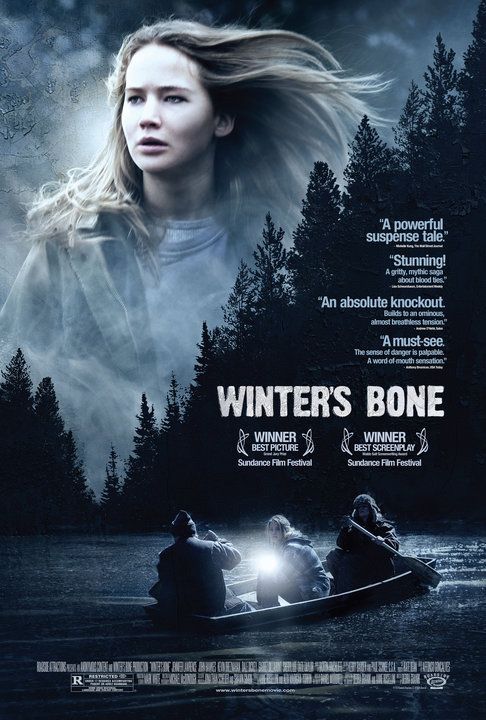
Winter’s Bone


Winter’s Bone

Based on a novel by Daniel Woodrell, of whom I was previously unaware but intend to check out in the near future, Debra Granik’s engrossing, immersive thriller is my clear favourite of the Festival. A dark drama that convincingly depicts a rural, poverty blighted society normally only seen as monsters in horror films, it also features a remarkable lead performance by Jennifer Lawrence.

Lawrence plays Ree Jolly, a 17 year old girl who – already responsible for her frail mother and two younger siblings – is told that her drug-dealing father has put their home up as security on his bail bond. Currently missing, he needs to show up for his court hearing or the family will be made homeless. Ree is obliged to undertake a dangerous quest to track him down – dead or alive.

In this desolate mountain town, drug addiction is endemic and drug dealing seems to be the major industry and source of income. The people involved, whose identities seem to be at best an open secret, are less than pleased to have Ree asking questions, and it soon starts to look as though she may the next to go mysteriously missing.

Watching the film, you can’t help but become angry that this young woman – who is demonstrably loyal, brave, occasionally droll – should be obliged to shoulder this kind of responsibility, even outside of the thriller plot. Looking at the older women in the film you see her likely future, and it’s infuriating. In a way, one of the most distressing scenes has Ree teaching her little brother how to shoot – distressing both because seeing small children handle weapons feels wrong, but also because you understand the lesson is actually necessary just so the family can continue to eat.

The supporting cast features a seamless blend of local people alongside more familiar faces like Deadwood’s John Hawkes, Garret Dillahunt and Twin Peaks’ Sheryl Lee. All contribute to the feeling that this is a window onto a very real, specific world, one rarely explored in cinema. It’s being released in the UK in September by Artificial Eye, and comes hugely recommended.

More Edinburgh Reviews

Thunder Soul
One of those films that leaves you feeling a little bit better about the world, Thunder Soul is the story of the Kashmere Stage Band, its founder, and its members. A Houston high school jazz band, Kashmere achieved local, national and even international fame in the 1970s under the leadership of committed music teacher Conrad ‘Prof’ Johnson.
The film centres on a reunion gig by past band members for their now 90+ and ailing Prof. All speak movingly of how his dedication and refusal to accept anything less than the best inspired and changed them, to the point where several credit him with keeping them out of jail. Meanwhile, some of the band’s more recent fans – their recordings have been widely sampled, and now re-released on CD – discuss how Prof revolutionised the high school band scene by introducing soul and funk, and amping up the performance.
Teachers like Johnson are not unique, but are sadly rare, and don’t always fit well into the system. Though he was responsibility for transforming the fortunes of the impoverished school, ongoing battles with the administrators eventually led to his retirement. He speaks passionately in interviews of the importance of music and arts programmes in schools; anyone who doubts their worth should be obliged to watch this film. Johnson’s legacy is clear to see: not just the music, but in the now fiftysomething students whose lives he transformed.

Boy
Every year at Edinburgh there’s one really good film about early adolescence and growing up (actually, this is probably true of most festivals). This year’s is set in a Maori community in 1984, and comes from Taika Waitiki (of Flight of the Conchords/Eagle versus Shark fame) and successfully mixes 80s nostalgia, comedy and family drama.
11 year old Boy is delighted when his father returns home after an extended absence. Supposedly there to reconnect with his kids, he’s really planning to dig up some hidden loot. Boy likes to see his father as a glamorous, fearless rogue, beholden to no man; he’s actually a petty crook and habitual spinner of tall tales.
Waitiki’s performance as the father may be the showiest turn but it’s the likeable group of child actors who stay with you the most, as Boy gradually comes to see his real father, flaws and all. The bittersweet elements are shot through with crowd pleasing visual comedy, culminating in a version of Michael Jackson’s Thriller under the end credits.

Pelican Blood
Pelican Blood starts Harry Treadaway as Nikko, a birdwatcher with a past of OCD and self harming which culminated in a failed suicide attempt. When his similarly troubled ex-girlfriend Stevie (Emma Booth) re-enters his life, his friends and family soon become concerned for his well being… with good reason.
I liked Pelican Blood while watching it, but seeing Third Star the following day really threw its flaws into sharp relief. We never learn the source of Nikko and Stevie’s self-destructive streak (perhaps there isn’t one) beyond the fact that they met on a suicide website.
Unfortunately, while the banter between Nikko and his fellow birdwatchers feel natural, his scenes with Stevie are artificial in comparison. There’s nothing wrong with shifting tones in a film, but in this case – though you are certainly rooting for a happy ending for Nikko – the film never really comes together as a whole.

Third Star
Like Pelican Blood, Third Star is about a young man facing his premature death. But this one is not self inflicted: James (Benedict Cumberbatch) has terminal cancer. While he still has time, he undertakes a camping trip to his favourite Welsh beauty spot with his three best mates.
Though the trip starts in a cordial manner, you know the quartet’s various tensions, neuroses and rivalries are guaranteed to come to the surface before the destination is reached. And indeed they do, prompted in part by various setbacks along the way, and partly by James’s desire to make his friends face up to their individual failings and compromises, inspired by his frustration that that they are failing to make the most of the years he has been denied.
Such a set up could easily lead to something unbearably clichéd and mawkish – as indeed it has, in countess TV episodes and films of the hugs and life lessons variety. Thankfully, Vaughan Sivelli’s fine screenplay skilfully avoids every potential trap, even having the character of Miles (JJ Feild) pour scorn on such hollow mawkishness. It’s coupled with four great lead performances – it’s easy to believe these four have really been friends for year – to make an immensely moving film.
The ending may be seen as depressing, but while it’s undeniably very sad, I found James’s defiance in the face of the inevitable also very uplifting. My second favourite film of the Festival.

Cherry Tree Lane and Jackboots on Whitehall

Cherry Tree Lane

Home invasion horror from Paul Andrew Williams, director of the much admired London to Brighton. Like that debut (he’s subsequently made The Cottage, which I haven’t seen) it’s a film that boasts some strong performances but is also manipulative, and has a credibility gap that makes it tough to buy into.

London to Brighton, the story of a prostitute’s attempts to protect a young girl from a gangster, lacked tension for me because I did not believe for one moment that the film was going to end with the murder of a child. Cherry Tree Lane, similarly, tries to unsettle the audience but a predictability to the plotting makes it hard to emotionally invest in the characters.

A suburban, 40ish couple (Tom Butcher and Rachael Blake) are eating at home when they are visited and tied up by three violent youths who are looking for their son. The film plays out in real time as they, and we, await the boy’s return.

The action is kept tight, the claustrophobic nature of the situation reinforced by keeping the shots largely confined to close ups. Much of the potentially upsetting images – specifically the rape of the wife by the young leader – are wisely kept offscreen, leaving us (and the husband) to mentally fill in the details. But in the climactic scenes the camera still holds back, when it should be dragging us into the thick of the horror along with the supposed viewpoint character.

Don’t be fooled into thinking this has anything to say about knife crime, youth violence or drugs culture. It’s a slasher film for middle class parents, pure and simple, and every bit as shallow and manipulative as that implies. If you accept it on these terms, the film succeeds reasonably well but for it to really work you need not to have seen Last House on the Left (others also disparagingly compared it to Funny Games). I have, and I didn’t need to see it again.

Jackboots on Whitehall

Bizarre animation that mixes It Happened Here with Team America: World Police. A starry cast, including Ewan McGregor, Rosamund Pike and Timothy Spall (as Winston Churchill) voice the Action Man/Barbie style characters in the story of a Nazi invasion of Britain following an unsuccessful evacuation of Dunkirk.

Though the film is rarely less than amusing, the jokes are far too thinly spread out – really, this is a terrific short film that’s been extended by about an hour too much. But the model characters are a joy, from big-naded hero Christopher to the Gollum/Scream style Goebbels and perpetually-smoking Churchill. Given how stiff the actual puppets are (their mouths flap, Thunderbirds style, but that’s pretty much it) they are surprisingly expressive. It all feels a bit childish though. You’re left with the feeling that it would be more fun to spend the time playing with all the fabulous little model soldiers, planes and tanks.

More Edinburgh Reviews

Huge

Ben Miller’s directorial debut, based on a play what he co-wrote, follows would-be stand up comedians Warren and Clark (Johnny Farrell and Noel Clarke) on the rocky road to fame.

It’s a bit of a mixed bag. After a nicely done meeting between the two (Clarke’s character heckles Farrell’s at an open mike slot, inadvertently giving him the only laughs he gets that night) there are some painfully plausible scenes of the two struggling to get their foot in the door of the capital’s comedy clubs. A host of real life stand ups cameo, some performing their own material, and you can have fun seeing how many you can name – many are familiar from TV, but others will be recognised only by those who frequent the live circuit.

Later scenes don’t feel so truthful. After the pair fall out, Clarke apparently becomes a minor celebrity as a chicken in a series of TV ads. How? Is this all he does? It’s not made clear. This seems to be an attempt to pull the rug from under the audience by first suggesting he’s become a star, before revealing he’s merely humiliating himself. It only confuses matters, and simply doesn’t work.

The real low point comes at the very end, with a series of images under the closing credits detailing teh duo’s future success ina way that brings to mind Bill and Ted’s Bogus Journey. It’s a major misjudgement, frankly – there’s been nothing in the preceding 84 minutes to suggest they could ever be that good.

Outcast

Werewolf on a council estate movie that does a pretty good job of mixing social miserabilism with gore.

A tabloid newspaper clipping posted in the delegate centre played up the fact that Karen ‘Amy from off of Doctor Who’ Gillan was appearing in a raunchy, bloody film shot before her TV fame; an unnamed (and possibly fictitious ‘film insider’ claimed the BBC would never let her do it now. The film immediately shot to the top of my must-see list. In the event, she’s only in a couple of scenes, and shows less skin than James Nesbitt.

Kate Dickie stars as mother to Fergus, a teenager who is being hunted by his father. It sounds like the set up for a drama about domestic violence, but the macguffin is more supernatural in nature. There’s a pagan/traveller background to the characters that might be bollocks for all I know, but it feels like it’s been fully researched. This, and the straight faced performances from all the cast – Nesbitt has thankfully left his Cold Feet/Yellow Pages twinkly-eyed schtick at the door – keep the film tense and grounded in reality.

That said, some of the plot details are left a little vague. I’m not fully clear on why the beast is cursed in this way – I think an explanation was proffered, but was buried under someone’s accent.

The beast itself is a thoroughly nasty looking piece of work, and the effects are good enough to avoid the atmosphere being punctured. Though the film feels a little like Ken Loach’s Stephen King’s Sleepwalkers, the well-maintained mix of setting and subject make it very much its own beast.

Soulboy

Coming of age drama set in the early 70s, with a nostalgic soundtrack. Christ, another one? Yes, and it conforms pretty much to expectations (it starts with an ironic promotional film for Stoke on Trent that recalls the opening of The Full Monty). The USP is the setting, based as it is around the famous Wigan Casino nightclub. Our hero (Martin Compston) is introduced to the music and moves by the beautiful but spoken-for Nichola Burley. In his attempts to impress her, he fails to notice that his classmate’s sister (Felicity Jones) is smitten with him. Which girl will he end up with? You may have already guessed.

The recent failure of Cemetery Junction to make the expected box office impact may count against the possibility of Soul Boy seeing the inside of many cinemas. A shame, as it’s a solidly-written, well performed tale, albeit a predictable one. Soundtrack’s pretty good, too.

Edinburgh Film Festival: The Illusionist

The new film from Belleville Rendez-vous director Sylvian Chomet is a reworking of a previously unproduced Jacques tati script. A lament for the dying days of Music Hall and old fashioned stage variety acts, it follows the titular stage magician as he journeys from France to Scotland in an attempt to earn an honest crust in a world turning to the newfangled rock’n’roll bands and television.

This kind of nostalgia for the lost clowns of a bygone age is something of an acquired taste, and I’ve never really acquired it – I find it all a bit too self-pitying. Yes, it’s sad to see a whole generation of performers being swept aside, but performers must know that the public is fickle. So perhaps it’s ironic that what I enjoyed most about the film is the defiantly old school craftmanship of the animation, the watercolour backgrounds and 2D artwork. It’s a pleasure to see this present and correct in a Festival that’s also running the 3D, computer animated Toy Story 3.

The film is infused with a strong sense of time and place, evoking life in an ancient city on the cusp of the swinging sixties; perhaps not surprising when you know Chomet moved the story to Edinburgh after falling in love with the city at a previous EIFF. The portraits of Edinburgh are a delight, as you find yourself mentally ticking off the locations – there’s North Bridge, there’s Princes Street, there’s Grassmarket – and they culminate in a breathtaking aerial panorama of the whole city by night that is over far too quickly. That brief scene is the lovliest thing I’ve seen at the Festival so far.

First couple of things seen at Edinburgh

Two Eyes Staring

Dutch chiller in which a family move into an old house inherited from Mum’s estranged mother, only to be threatened by a Dark Family Secret. Early on, Dad Paul remarks “You could fit a whole orphanage in here,” which only further serves to remind one of the Spanish film – though this time it’s the nine year old daughter, rather than the mother, who may or may not be seeing a ghost.

This starts out well, with the mysterious noises and sudden spectral appearances all handled well (including a classic something-under-the-bed moment). But in plot terms, things go a bit awry in the second half. While director Elbert van Strein and his co-writer Paulo van Vliet manage to keep us guessing about what’s really going on, the final revelations make the nature of the haunting very clear (though to be fair, the twist is not the one I had been expecting). I like a little more ambiguity in my ghost stories. But it remains a worthwhile watch for J-Horror fans, and has an excellent performance from child actor Isabelle Stokkel, who manages to switch between childish glee, terror and blank-eyed menace as required.

The Last Rites of Ransom Pride

Perhaps it’s because I saw this right after the slow-burning Two Eyes Staring, but Tiller Russell’s western began to annoy me immediately. With it’s flashy sharp cutting, time-lapse shots and brief flashbacks used as scene breaks, it’s the very definition of (attempted) style over substance. And that’s a shame, because there’s some potentially good stuff in here.

Lizzy Caplan, who looks remarkably good for someone who lives a pretty rough life, stars as Juliette Flowers. Her attempts to retrieve the body of her outlaw lover Ransom Pride make her, and ultimately Ransom’s younger brother, thye target for a string of killers. The film boasts a number of what could have been interesting characters, and a fantastic supporting cast: among them, Peter Dinklage as a shotgun wielding dwarf, Dwight Yoakam as an alcoholic killer turned preacher, and Jason Priestley (who I would never have recognised in a million years) as a thoroughly unpleasant bounty hunter.

Sadly, their work gets no opportunity to shine, as Russell seems perpetually in a rush to get to the next scene (the picture only runs to 84 minutes). It also suffers from having been shot digitally, presumably for budgetary reasons, leaving the fast action – already cut so quickly you can barely tell what’s supposed to be happening – with that irritating blurry effect you get with digital filming. This could have been so much better, but as it stands is eminently missable.

Couple of quick mentions for two more good films: World’s Greatest Dad, a black comedy starring Robin Williams, and The People Versus George Lucas, a documentary about Star Wars fans and their love/hate relationship with the films’ creator.