Author Archives: Gareth Negus

Edinburgh 2011 reviews

The first couple of days of screenings here have been a mixed bag. John Michael Macdonald’s The Guard turned out to be a fine choice for opening film: a hugely entertaining crowd pleaser which sees In Bruges meet Lethal Weapon. The shared lineage with the former film is evident throughout; not only are the directors brothers,  there’s the presence of Brendan Gleeson, on top form with the hilariously sweary dialogue. Here, Gleeson’s deceptively undistinguished Garda officer is teamed with Don Cheadle’s FBI agent to track down  team of drug smugglers led by Liam Cunningham and Mark Strong.
The Argentine end of the world drama Phase 7 had it’s moments, but some odd shiftsin tone meant I couldn’t enjoy it as much as I would have liked.  As society collapses under the onslaught of a deadly virus, a young couple hole up in their apartment block while their neighbours take up arms against each other.  
The scenario is played mostly straight, but with occasional jarring lurches into black comedy and slapstick that do little more than diffuse tension.  Worse, the central couple are quite annoying –  he guy is petulant  and unreliable, while the woman spends most of her time complaining (often with some cause, but still).  I was also distracted by the score, which is a homage (or rip off, if you’re feeling less charitable) of John Carpenter’s back catalogue. I’ve seen worse, but it’s not a total success.
Much better is Tomboy, a tween variant on Boy’s Don’t Cry, from Water Lillies director Celine Sciamma. Lead character, a 10 year old girl called Laure, moves house and impulsively pretends to the local kids that she’s a boy. It’s very plausible at first – lead Zoe Heran is remarkable, and the film actually conceals her gender for the first 10 minutes – but the illusion proves harder and harder to maintain, and you’re soon dreading the inevitable. A moving, believable film with a  collection of superb child performances.
The Hungarian auteur Bela Tarr makes films for people who find the works of Ingmar Bergman to be on the frenetic side.   Turin Horse, which may apparently be his final work, is described in the programme this: “In Turin in 1889, the philosopher Fredrich Nietzsche stopped a cab driver from whipping his horse and promptly collapsed, spending hs remaining years in more or less demented silence.” Quite what this has to do with the events we seeon screen I’m unclear, though “demented silence” is certainly how the two main characters live. A man and his adult daughter living in an isolated house on a permanently windswept plain, we see then going about their daily routine: feeding the horse, cleaning, cooking (their diet consists of boiled potatoes and nothing else).
Gradually we become aware that something is wrong: a neighbour visits with warnings of doom, the horse become sick and refuses to eat.  Just what apocalyptic events are  unfolding we never learn: we simply observe the two people descend into silent, baffled despair.
Tarr – who has also programmed some vintage Hungarian cinema for this year’s EIFF – can only be described as an acquired taste. His work makes no concessions to those who enjoy such things as plot and dialogue. You have to be willing to immerse yourself in his bleak, black and white, doom-laden visions to get any kind of pleasure from this film; not everyone will be willing to make that kind of leap.
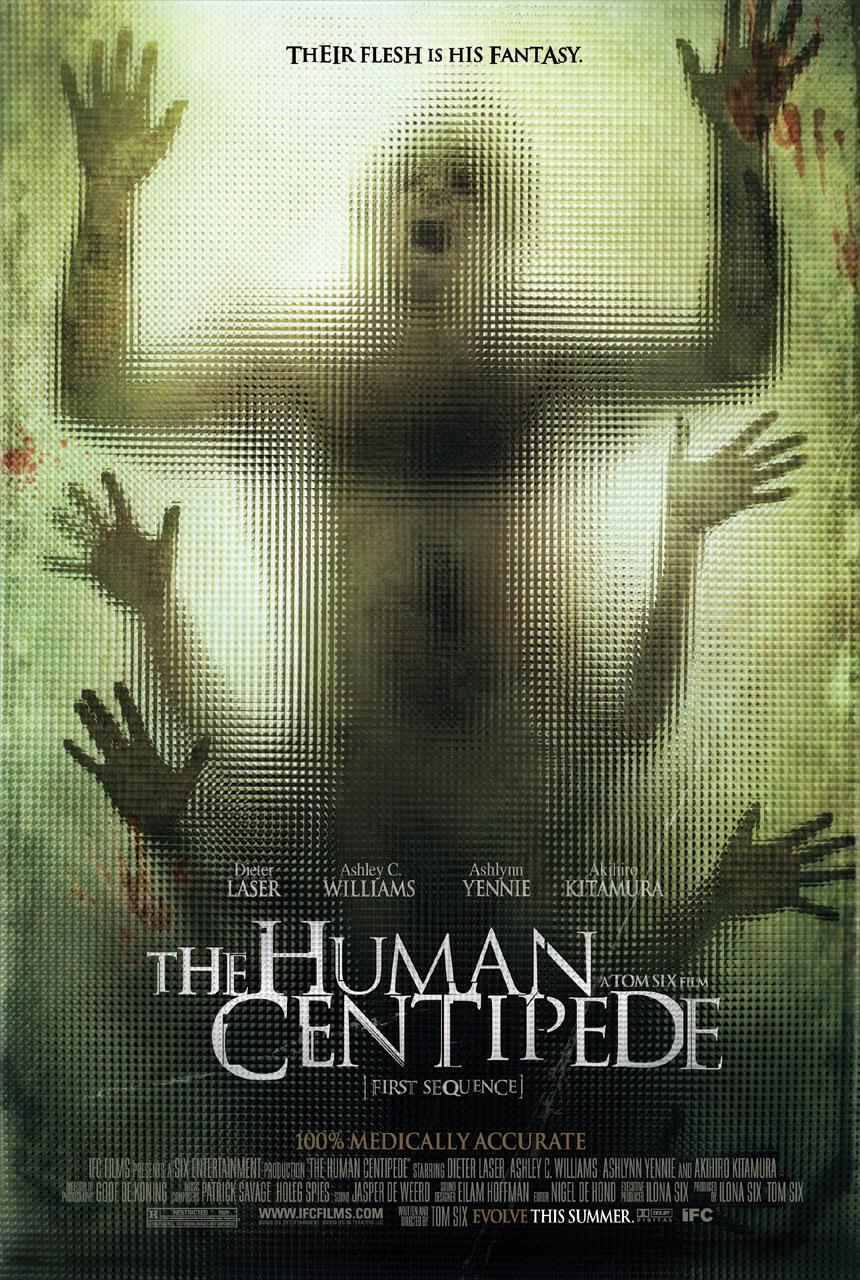

Some thoughts on the BBFC ban of Human Centipede 2: Full Sequence

So the BBFC have banned Human Centipede 2: Full Sequence.  It’s very rare for them to refuse a certificate outright – it’s usually a matter of a few cuts, often to achieve a lower certificate.  But this time it’s a flat no.  Nobody in the UK will be able to watch the film legally.  And my first thought was: Oh, thank fuck for that.
This disturbed me a bit, because I think of myself as being someone opposed to censorship of this nature.  Certification, sure, making it clear that some material isn’t suitable for children – don’t have a problem with that.  But telling adults that they aren’t grown up enough to watch a film, one that consists of a made up story performed by actors in the process of which nobody was hurt?  That’s just not on. 

My feeling was always that you’re either against censorship or you’re not.  It’s no good being against it until you run into something you personally find offensive; that’s easy.  It’s arguing for the right of people to watch (or read, or hear) material that turns your stomach that’s the challenge.  And I used to be able to do that; I’ve no desire to see I Spit On Your Grave, for example (either the original or the recent-ish remake) but I’m happy to accept the makers’ assurances that its not intended as porn for rape fantasists and allow it to be seen by consenting grown ups.  Years ago, I went to see Henry: Portrait of a Serial Killer partly because of the trouble it had getting a UK certificate.   More recently, I went to a screening of Last House on the Left at the ICA, aware that it might be my only chance to see it (it’s since been released uncut on DVD).  It was horrible, but given the subject matter it should be.
This was partly because my interest in film started forming at around the time when a fair few of the films I would have liked to see were banned.  I hadn’t really noticed the Video Nasties furore, which led to the passing of the 1984 Video Recordings Act; I was just a couple of years too young to take an interest.  I only really found out about it a few years later, when I picked up a copy of Martin Barker’s book The Video Nasties: Freedom and Censorship in the Media.  This was how I discovered the reasons why I wasn’t allowed to see (among others) The Texas Chain Saw Massacre or The Exorcist. 

I was particularly suspicious because of the sort of people who were making these decisions for me; they seemed to be ghastly Bible-bashers of the James Anderton variety, or hysterical ‘think of the children’ types.  None of them seemed to speak for me, or have any grasp of the kind of films I was interested in.
But Human Centipede 2 is something else.  It’s partly because I’m getting older; unrelenting misery and nihilism just doesn’t seem as clever to me as it did when I was a sixth former.  Call me a big old softy, but I like a happy ending, or at least a glimmer of hope (which is why I still enjoy the Saw films: Jigsaw’s trying to help those people, not kill them!).   I found Human Centipede 1 to be a thoroughly repugnant film, one that depressed me just by existing.  Yet it’s apparently a picnic compared to the follow up, which the BBFC press release tells us “Unlike the first film, the sequel presents graphic images of sexual violence, forced defecation, and mutilation, and the viewer is invited to witness events from the perspective of the protagonist. Whereas in the first film the ‘centipede’ idea is presented as a revolting medical experiment, with the focus on whether the victims will be able to escape, this sequel presents the ‘centipede’ idea as the object of the protagonist’s depraved sexual fantasy.
I certainly won’t lose any sleep from being denied the opportunity to see that.  But looking at the extended plot description, I can’t help wondering if there isn’t something more going on here than the desire to shock.  The BBFC release tells us the story is about “a man who becomes sexually obsessed with a DVD recording of the first film and who imagines putting the ‘centipede’ idea into practice… [there is] a scene early in the film in which he masturbates whilst he watches a DVD of the original Human Centipede film, with sandpaper wrapped around his penis, and a sequence later in the film in which he becomes aroused at the sight of the members of the ‘centipede’ being forced to defecate into one another’s mouths, culminating in sight of the man wrapping barbed wire around his penis and raping the woman at the rear of the ‘centipede’…”
What’s interesting is that the first film is here presented as a fictional work, and the villain is one of its viewers.  It’s worth asking what director Tom Six is up to.  Is he simply looking for a way to outdo the first film, or is he deliberately asking viewers to identify with his lead character?  If so – if he has switched to making his torturer into the viewer’s point of identification, something you couldn’t say of the first film – is he implicating the people who watched and enjoyed his previous work? 

From this perspective, Human Centipede 2 sounds closer to something like Michael Haneke’s Funny Games than anything else.  Maybe he’s telling us that anyone who enjoyed the first film must be sick in the head.   In that case, perhaps he’d agree with the BBFC’s ban. 

The public mood changes over the years; many of the formerly banned video nasties have re-emerged uncut on DVD.  Some can still shock, but in many cases you would wonder what all the fuss was about.  Maybe the same thing will happen to Human Centipede 2; it’s hard to say, as I’m not allowed to see it.  Perhaps I’d better keep an eye out for downloadable versions.  That, or just shrug it off and accept that I’ve started to turn into a Tory.

Edinburgh 2011

So with about a month to go before it starts, the Edinburgh Film Festival programme has been released.  And it’s… interesting.
This year’s EIFF has been hit by funding cuts – a deal with the UK Film Council to support the move to June ended last year – and it’s noticeably smaller than before.  Big premieres are noticeable by their absence (there’s no closing night film, for example, and no Best of the Fest on the final Sunday… maybe they’re not anticipating many sellouts).  More puzzlingly, there’s no Michael Powell Award for Best British Film, which was something that made Edinburgh stand out from the rash of festivals, and can’t have encouraged the submission of potentially major films.  
One film widely expected to be in the programme was We Need to Talk about Kevin, starring as it does EIFF Patron Tilda Swinton.  Unfortunately, it’s late 2011 UK release date means Artificial Eye are holding it back – a perfectly sensible decision from their point of view (a UK premiere at the London Film Festival will make more sense), and there’s nothing new about big Cannes titles failing to show up in Edinburgh. 
The Festival has retreated entirely from the Cineworld to the Cameo and Filmhouse (plus a few others).  No doubt some will see this as a good thing – there is grumbling from the some sections of the press every year about having to see films in a multiplex usually patronised by – shudder – ordinary cinemagoers.  To this I say, bollocks.  Quite apart from the fact that a Festival of this nature ought to be reaching out to the non-Sight and Sound reading contingent, the Cineworld is a perfectly acceptable venue.  Certainly, after a few screenings on the trot in the cramped and often stifling Filmhouse 1, I invariably find myself thinking wistfully of its generous leg room and air conditioning.
Given that last years EIFF was widely reported to have seen a drop in audiences (though by how much, and how it compared to the Festival’s last year in August, I don’t know; can anyone point me to the info?) it will be interesting to see how the organisers spin the eventual ticket sales for 2011.  I’m not suggesting that ticket sales are the only indicator of a Festival’s success, but if last year’s event is being tagged by some as a disappointment, how will they react to an inevitable drop in a Festival almost half the size of its predecessor? 
So, what have we got?  The theme is ‘All That Heaven Allows’, which means… um… well, I’m not sure, really.  It does involve a screening of the Douglas Sirk film of the same name, though.  And it has involved films being picked by a number of guest curators.  Some of these are very interesting choices; Bela Tarr, for example. He’s programmed Passion, a 1955 Hungarian version of The Postman Always Rings Twice.  I can’t imagine getting too many other chances to see that. But there are quite a lot of guest curators, and they only seem to have picked one or two titles each.  I would have preferred to have seen a more substantial selection from one or two curators. 
But that’s enough grumbling; what am I actually looking forward to seeing?  Well, The Guard looks like a promising pick for the opening night.  I rarely get a must-see feeling about big screen documentaries, but a sensible link up with Sheffield’s documentary festival has created a strong non-fiction strand; my top picks are Bobby Fischer Against the World, Sound it Out (about an independent record shop) and Project Nim, from James Man on Wire Marsh.  Studio Ghibli bring us the Mary Norton adaptation The Borrower Arietty (though the purist in me is vaguely resentful we seem to be getting the dubbed version). There’s The Last Circus, the new Alex de la Iglesia, and a number of horror/fantasy titles; I’m most anticipating Norwegian mockumentary Troll Hunter, but there’s also the Argentine end of the world tale Phase 7, and something called Rabies, about which the brochure seems oddly sheepish (“Horror fans will love this”, we’re assured, though it’s “silly”).
But brochure copy only tells you so much; the jury will remain out (even though Edinburgh doesn’t have a jury this year) until we’ve been able to see the films.  It’s a big year for the EIFF, one the organisers readily describe as being transitional, and I’m hoping it will work.  Either way, it will be interesting to see the choices the Festival makes for its future.

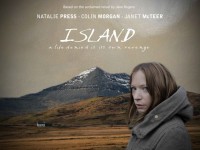
Island

Island is one of those low-budget, defiantly arthouse British films that impress just by existing, but which you can’t wholeheartedly suggest people rush out and see.
Adapted by Elizabeth Mitchell (who also co-directs, with Brek Taylor) from a novel by Jane Rogers, it starts with a voiceover by Nikki (Natalie Press), stating, “When I was 29, I decided to kill my mother.”  Mother is Phyllis Lovage (Janet McTeer), who lives in an isolated cottage on the titular Hebridean land mass with her son Calum (Colin ‘Merlin’ Morgan).  Brought up in foster care, Nikki has discovered her mother’s identity and is intent on getting some answers, and possibly taking a violent revenge for her lost childhood. 

Island is billed as a fairytale thriller, and that was probably why I couldn’t get too involved with it.  It relies a lot for its atmosphere on shots of the foreboding Scottish landscape, probably too much (though I was at a disadvantage here, watching a screener DVD on TV; I don’t doubt that this aspect would work better on the big screen.)  I’m tempted to suggest that the landscape did quite a bit of the first-time directors’ work for them, but that might be too harsh.  While I found some of the dialogue scenes to be flatly shot, there are a number of visual moments that come close to the otherworldly feel the film is reaching for – in particular one fog-bound scene that I initially took for a dream sequence, and moments when Nikki’s drawings spring to animated life.   

The small cast is strong, but they can’t make their characters feel like real people.  They are kept isolated from any wider community – we never see anything of Nikki’s life in London, and even the villagers of the island are confined to a few cameo appearances.  It’s difficult to care whether Nikki will murder her mother or not.  Theoretically Nikki is becoming fascinated by the island, to the point of believing the fairy tales Calum narrates for her, but the script is too thinly written to really sell the change.  Consequently there are few surprises as the film moves toward what the Screen International review accurately describes as “the expected mildly shocking ending”. 

The film is being released in the UK by Soda Pictures through the New British Cinema Quarterly scheme (http://www.nbcq.co.uk/), which last year proved its worth by bringing us the excellent Skeletons.  NBCQ films are given small releases, typically with the cast and/or crew touring independent venues across the country to support the film with Q&As.  This strategy is the best chance for a film like Island, which would otherwise go unseen outside festivals, to find an audience; it sounds harsh, but I find it is sometimes more interesting to hear about the process of completing a film like this than it is to actually watch it (I don’t doubt that it’s hard work getting something completed just so that people like me can damn it with faint praise on the internet).  That said, though I felt the film fell short of its aims, I’d certainly prefer to have British films like Island make it into cinemas rather than another gangster/football hooligan B-movie aimed at the DVD market.  More details of screenings can be found here: http://theseachange.wordpress.com/

Limitless

Warning:  this review contains spoilers.  Sorry.  Couldn’t really discuss it without talking about the ending.
Bradley Cooper discovers that the drugs do work, and extremely well, in this watchable thriller that doesn’t seem quite sure which side it’s on.
Cooper plays Eddie Morra, a failing writer freshly dumped by his exasperated girlfriend (Abbie Cornish, who is almost completely wasted in this). He happens to bump into his ex-wife’s brother who slips him a sample of MDT, a new pill that allows the user to access 100% of the mind’s ability.  Unfortunately, it turns out that the pills aren’t quite as legal as Eddie had been led to believe, and he soon finds himself in possession of a large but finite stash on which he is becoming increasingly dependent, and which quite a lot of other people will kill to possess.
This feels at first like a spin on the Faust story – someone given everything they ever wanted, with no apparent strings attached.  Eddie wins back his girl, becomes a successful writer, and starts to make millions on the stock market.  But of course there’s going to be a price to pay, sooner or later; we know that, even if the opening scene hadn’t made it explicit.
Much of the film is good.  There are twists; the identity of the person or persons following Edgar is kept well concealed – and director Neil Burger is particularly strong on the disorienting effect of the drug as Eddie starts to lose chunks of his memory. The difficulty is that Edgar is not a particularly sympathetic character.  He starts out as a self-absorbed loser, becomes a drug-dependent overachieve, and at one point appears to have killed a woman (he can’t remember, and seems more concerned with the possibility of being arrested than with the idea that he might be guilty).  Cooper’s movie star looks and a degree of charm allows him to carry us with him to an extent (Shia LaBeouf was apparently up for the role at one time, which would have been a different story) but even so, we want to see him brought down and learn his lesson. 

But here’s what’s curious: he doesn’t.  He merely learns how to control his intake of the drug to prevent ill effects.  By the end he claims not to be using, but it’s unclear (presumably deliberately) from Cooper’s performance if this is true or not.  Which begs the question: what has he learned?  How has he grown as a character?  He’s standing for public office, but for which party?  What are his campaign goals and promises?  Is he simply out for his own glory, or is he planning to use his influence to make the world a better place?
We’re not told.  Consequently, Limitless becomes the tale of a man who achieves incredible success, fame and wealth by taking illegal drugs and getting away with it.  Which somehow seems a little… odd.

My Oscar predictions

This year’s Oscars have a pretty good selection of films up for awards; it’s so good, in fact, that I worry a bit that the next six months will see nothing but crap released (bit of a worry when you run a cinema).  Whereas the Golden Globes were reduced to nominating The Tourist, and the BAFTAs managed to miss the fact that Winter’s Bone had even been released, the Oscars have managed to avoid any obvious omissions, and are pretty low on undeserving nominations.  I’ve seen all the Best Picture nominees except The Kids Are All Right, so I’m having a crack at predicting the results of the major awards.
I’ll start with the no brainers.  Natalie Portman clearly has Best Actress in the bag, and that’s in a year when she had a lot of strong competition (after Edinburgh this year I was certain Jennifer Lawrence had already nailed it).  She’s the perfect candidate in that great things have been predicted for her since Leon, but she’s never really given the performance everyone thought she was capable of (possibly because the right role just hasn’t come along).  Black Swan itself may be love it or hate it (I loved it myself) but most would agree this is a triumphant turn by someone who always seems like a nice person.  I don’t think anyone (well, maybe Annette Bening) would begrudge her the award.
Similarly, it seems pretty clear that it’s Colin Firth’s turn.  He’s come close before, so he’s shown patience and earned his spurs.  And he is genuinely very good in The King’s Speech. 

As for the rest, I would like to see The Social Network run off with the bulk of categories.  However, it’s facing the twin threat of a reliable, very well made, traditional British costume drama on one side and a reliable, very well made, traditional American costume drama on the other (King’s Speech and True Grit).  I might be wrong, but I suspect the Academy hive mind will share the awards out between these two, though I wouldn’t want to guess which will get Best Picture, with a smattering for the others.  Aaron Sorkin should get something for the screenplay, but that could well be the lot.
The Supporting Actor/Actress awards are tougher to call.  This is The Fighter’s best chance of picking up an award (well, unless it gets Best Sound Editing or one of the others that nobody really cares about) so it’s supporters may well decide to concentrate their votes here.  However, I will be actively enraged if Christian Bale gets something for his manic, scene hogging turn.  I don’t care how close he is to the real person he’s playing; it’s too big for the film.  But they love giving Oscars to people who play real people, and Bale is generally seen as Oscar worthy.  Just not for this one, please.  Similarly, though I’ve been a fan of Melissa Leo since her time in Homicide: Life on the Street, her turn in The Fighter is pitched to match Bale’s, and therefore becomes part of the problem.
I would rather see John Hawkes rewarded for Winter’s Bone, and Hailee Steinfield for True Grit (even though she’s playing the lead and should not, therefore, be in this category).  But I wouldn’t be totally surprised if the King’s Speech juggernaut takes these as well.
For director I would pick David Fincher, but the Coens will probably take it, leaving Original Screenplay for The King’s Speech.  Not an ideal split, but at least the nominations are fairly spread over a good selection of films, so everyone will have something good to put on the DVD covers.

A small lament for the death of FU

This morning, like most other mornings, I went online via my phone to have a quick look at any new posts on Film Unlimited, the film section of The Guardian’s talkboards.  Only to find it wasn’t there.  Someone had killed it overnight.
Maybe I shouldn’t have been quite so surprised.  There were rumours about it a few years ago, and I had noticed the ‘talk’ link had recently disappeared from the menu of the main Guardian film site; but that’s happened before and FU survived, so I just altered my bookmarks and thought nothing more of it.  Little did I realise that the End Times were upon us.
I’ve been posting on FU for seven years (I remember my first post was on The Passion of the Christ, so it was easy to check the date).  I had tried to start earlier; I first registered during the BBC2 run of 24 season 2, because the thread for that show was hilarious and I wanted to join in.  Unfortunately the registration process took so baffling long that by the time Frank100 was up and running, the season had ended.
In that time, it’s been rare that I’ve gone more than 24 hours without checking in.  I haven’t always posted, but I’ve always been reading.  The number of regular posters in that time has always been fairly small, but that’s partly why I liked FU so  much – it was relatively easy to get to know who was who (although people would sometimes switch usernames, causing temporary confusion) and to tune in to the various in jokes.  Maybe that did make the place feel cliquey on occasion, but it was the right kind of cliquey, if you see what I mean (and newbies were hardly unwelcome, so long as they could get past being asked if they were Wolfie).  Some of those people I’ve since met in real life; others I’ve only spoken with on the boards, but they feel like friends anyway.
Some of my personal highlights since have been TV threads for Harper’s Island and the Andrew Lloyd Webber talent shows, being a temporary dictator, and occasionally finding hundreds of new posts on a thread and realising there’d been an almighty row overnight.  On the morning of the 7/7 attacks, FU was the best place to get updates on what was happening in central London.  People were always ready with advice, and when I received a misaddressed threatening letter from an amusingly inept stalker a few years ago my first thought was, “Ooh, I must tell people on FU about this.” The releases threads were saved, going back years, and only last week I tracked down the thread for The Ruins after watching that film for the first time on TV.  Good stuff was happening right up to the end, with the True Grit thread being busy yesterday.  All of it gone, presumably forever.  It’s hard to believe I’ll never be able to read that Lost in Translation thread again.
I’m sure the Graun had valid reasons for axing the Boards, and for doing so without any warning worthy of the term.  There are other places on the web to gather; I’ve followed a further dozen or so FUers on Twitter so far today, and most followed me back in minutes.  Nothing’s really changed, except that the Guardian has lost a little bit of my loyalty.  But I’m feeling a tiny bit bereft all the same.  

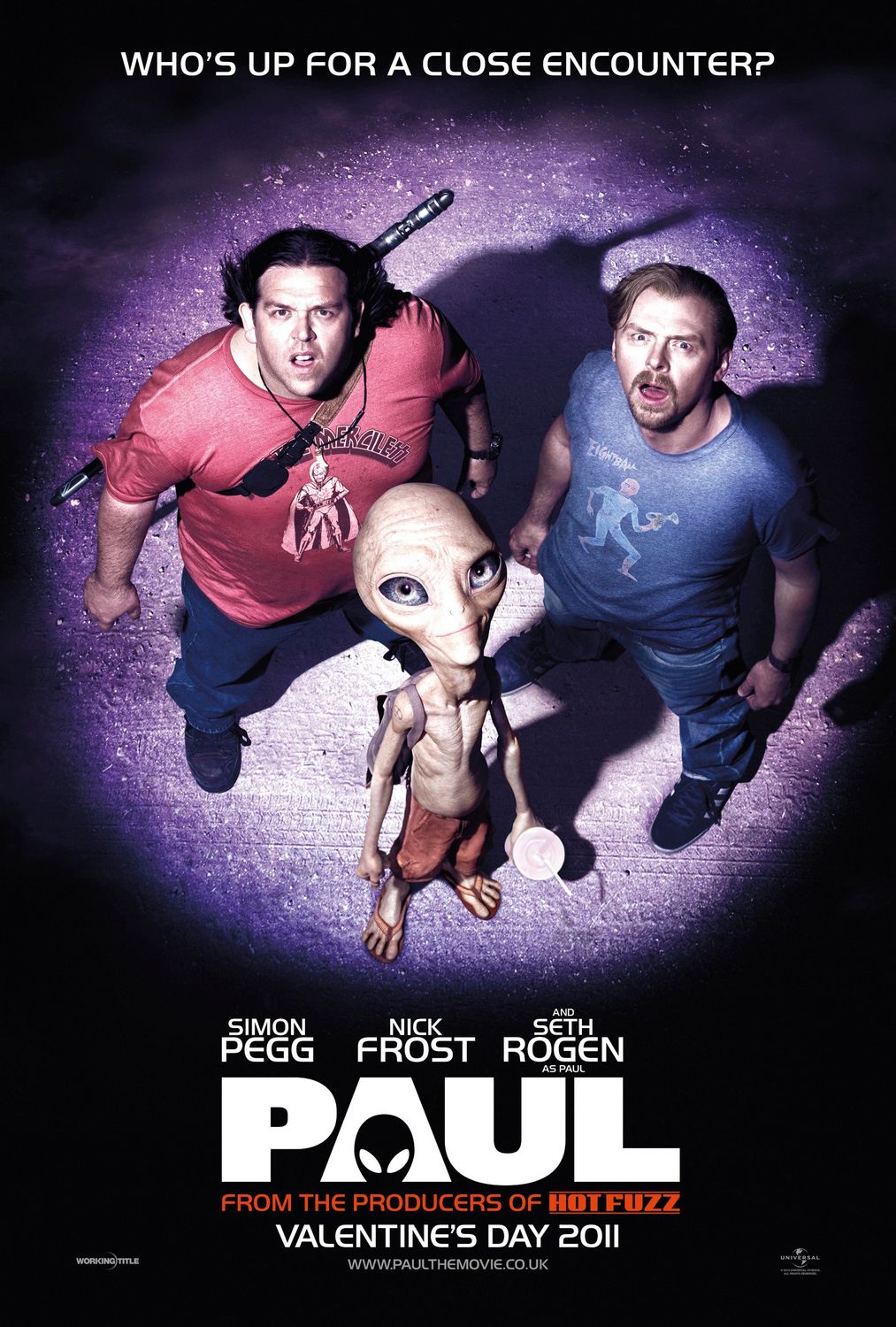
Paul

An amiable ramble down the highways of UFOlogy, Paul has writers/stars Simon Pegg and Nick Frost doing their geek bromance routine in America.  Blending the genre parodies of Hot Fuzz and Shaun of the Dead with Judd Apatow style frat comedy, it’s a likeable enough piece that could maybe have tried a little bit harder.
Edgar Wright being busy elsewhere, the director is Greg Mottola (Superbad and the excellent Adventureland), with fellow comedy regular Seth Rogen providing the voice of the titular Grey alien.  On the run from Jason Bateman’s Man in Black, Paul chances across Graeme Willy (Pegg) and Clive Gollings (Frost), two SF fans touring the UFO hotspots of America in a rented RV, and hotches a ride to the planned rendezvous with his people. 

The main reason Shaun and (to a slightly lesser extent) Hot Fuzz worked was because the scripts were good.  It didn’t matter if you’d never seen the films they riffed on, because the characters felt three dimensional, if broad.  Paul doesn’t hold up quite so well.  The two leads are affectionately drawn, but slightly too obvious: nervous around women, fond of comics, shielding themselves in fantasy.  It’s a little closer to the average person’s view of Comic Con attendees than it needs to be.  The matey camaraderie between the two helps (you suspect the trip is a dream come true for the actors as well as the characters).  The script also falls into the trap of quoting other films, verbally and visually, as a wink to the fanboys in the audience so frequently that it becomes irritating rather than funny. 

But these are minor points; my one major reservation about the script is that it takes the route of making the local small town folk the lads encounter to be bible and/or queer-bashing rednecks, which just feels lazy.  Worse, there’s a peculiar plot strand in which Paul proves to Simon Pegg’s love interest (Kristen Wiig) that God doesn’t exist, and all the beliefs she was raised with are wrong.  There’s no debate about this: the film takes it for granted that everyone watching will share this worldview and be ready to laugh at anyone who doesn’t.  It’s a peculiar attitude for a comedy to adopt, and one which will surely cost it some potential ticket sales, particular in the areas where it’s set (I can’t wait to read the capalert review). 

If you can get past that, there’s plenty of entertainment to be had.  A terrific support cast includes Sigourney Weaver, Jeffrey Tambor, and Bill Hader and Joe Lo Truglio as Bateman’s stooges.  These last two provide a lot of the biggest laughs.  And Paul himself is an impressive bit of CGI.
Paul is one of those films you can’t actively dislike, and it benefits greatly from picking up the pace in the last act.  It’s a shame that so many of the best gags are in the trailer, though there is some material on Paul’s influence on popular culture that I enjoyed a lot.  Overall, a fair crowdpleaser  that should find an audience among those with no religious sensibilities whatsoever.

Top 10 2010

This year I’ve seen 125 films; 115 in one of 21 various cinemas and another on screeners and in various video rooms.   I imagine I’ll squeeze in a couple more before 31 December, but unless Tron: Legacy turns out to be much less shite than I anticipate, my top 10 list of the year is pretty much set. 

It might look a bit different if I’d manage to catch everything I wanted, but inevitably one or two of the limited releases slipped through my fingers (Uncle Boonmee and Still Walking being chief among them).  Anyway, the ten have been arrived at without much in the way of deep thought – I’ve basically picked the ones I enjoyed most at the time, and arranged them in an approximate order.  The top five, I think, are essential viewing; the rest maybe less so, but all provide solid entertainment that’s more interesting than average.

Tenth place was a struggle, and I nearly bottled the choice by replacing it with a whole bunch of runner ups.  But in the end, The Illusionist, The Runaways, The Last Exorcism and The Town all had to settle for honourable mentions.  No doubt they’re gutted.

10. Skeletons
A film I very nearly walked out of after about 20 minutes, but thankfully stuck with.  A very peculiar British fantasy comedy drama it’s certainly not for everyone, but edges out the competition by being completely its own thing.

9. The Secret in Their Eyes
One of those films that was greatly enjoyed by an audience you suspect might have shunned it had it not been subtitled.  Never mind, it was melodramatic tosh but I enjoyed it greatly for all that.

8. Dogtooth

7. Monsters
This gets pretty much everything right, starting with a first appearance by a monster that’s as exciting as the one in The Host. After that we spend more time with the two leads than with the aliens, which is fine as they’re both very likeable and they’re traveling through some lovely scenery. Unfortunately I have some issues with the ending; I had been hoping throughout that they wouldn’t go that cynical horror movie route where you think everyones survived and then they haven’t.  But they did. 

6. Inception
My top ten usually has space for the year’s best blockbuster, and this was 2010s.  An original screenplay (well, original in the sense that it’s not based on a comic book or another film – obviously it has its own antecedents), excellent cast and loads of cool visuals make it superior multiplex fodder.

5. Mother
A Bong Joon-Ho film is worth watching pretty much by definition, and if this didn’t seem quite up to his brilliant Memories of Murder it’s only because I now have such high expectations of him. 

4. Four Lions

3. Toy Story 3

And the final two, which could easily switch places:
2. The Social Network

1. Winter’s Bone

Some stuff I saw over the weekend

A big weekend of films meant I saw rather more Helen Mirren and Guy Pearce than is average for me.  Some of the 10 titles I managed to fit in weren’t that great, or offered little unexpected to say – yes, The King’s Speech was excellent and is certainly highly recommended, but that’s hardly a surprise at this point – but there were some unexpected treats too.
Chief among these was Catfish.  I went in knowing little about it, and what I did know turned out to be wrong (I’d been mixing it up in my head with a different film).  This turned out to be the best way to see it, and I’d advise doing the same if at all possible. 
It’s a documentary that follows photographer Nev Schulmann, his filmmaker brother Ariel and their collaborator Henry Joost after Nev strikes up an online friendship with a talented child artist (who has painted a copy of one of his photos and sent it to him).   He also becomes close to her family, particularly her older sister.  At times it’s fairly uncomfortable viewing, and left me feeling that I was watching something that should have been left private.  You can’t help but question the filmmakers’ motives for continuing with the production, though Nev is seen to act with considerable sensitivity and dignity in the later scenes.  Some may also wonder if the fly on the wall material is genuine (certainly one person at the screening believed the whole thing to be a scam, not an opinion I share).  Either way, it’s a fascinating story.
If you though the only thing wrong with The Reader was that it didn’t have enough guns and fights, then John Maden’s The Debt is very much the film for you.  Helen Mirren gives some serious accent as Rachel Singer, an ex-Mossad agent whose daughter has written a book about her most famous mission – the capture and killing of a notorious SS war criminal.  Cue flashbacks, plot twists, betrayals, the works.
I’d heard bad things about this one, so my expectations were low enough that I actually enjoyed myself.  It’s a potboiler, and a rather self-important one, but entertaining for all that.
Mirren also had her classical hat on for The Tempest, Julie Taymor’s latest Shakespeare adaptation, playing the renamed Prospera in a gender swap that works perfectly well.  Most of the rest of the cast are good as well: you get that nice Felicity Jones as Miranda, classy US types Chris Cooper and David Strathairn, plus Russell Brand.  Brand looks just like he always looks, but is fine in the comic role of Trinculo, and manages (like Mirren) to make Shakespeare’s lines sound like normal dialogue.  The only weak link is Reeve Carney as Ferdinand, who really is extraordinarily wet.  Given the play’s subtexts though, I’d be interested to know if Taymor thought long and hard before casting Djimon Hounsou as Caliban.  I’m not saying it was a bad idea, I’m just interested.
The film looks spectacular.  The locations – it was filmed in Hawaii – are stunning, and various scenes are augmented by CGI, most extensively with the transformations of the spirit Ariel (I was reminded of Dave McKean’s film Mirrormask at several points).  But you never get a proper sense of the geography of the island.  Instead, various groups of actors step out onto the stage, do their scene, and are replaced by others – always a risk with theatrical adaptations, of course. 

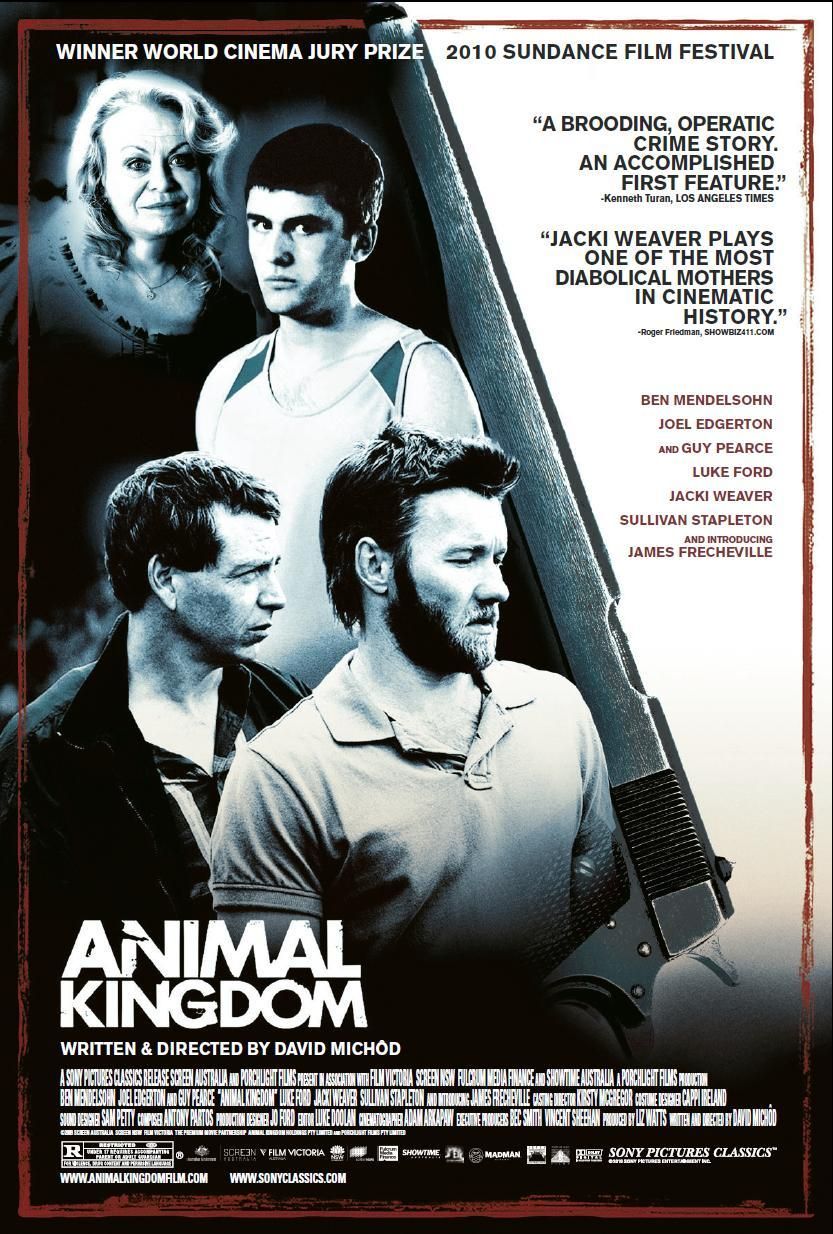
Finally, another highlight – David Michôd’s Animal Kingdom, an excellent Australian crime drama following Josh (James Frecheville), a 17 year old who is taken in by his criminal family when his mother fatally overdoses.  Already you can see that the odds are not in his favour, and soon he’s being drawn into his relatives’ nefarious activities – which are notorious enough to draw the attention of the ruthless Armed Robbery Squad.  These relatives and their associates range from reasonably decent (Joel Edgerton as Barry, Luke Ford as Darren) to dangerously unpredictable (Ben Mendelsohn as Pope), headed by the thoroughly loathsome mum from hell Janine (Jacki Weaver). 

Frecheville plays Josh with a blank-eyed reserve that could initially be mistaken for woodenness, but is in fact a very good portrayal of an inarticulate and confused youth.  Guy Pearce is also in there as the cop trying to persuade Josh to stay on the straight and narrow.  There’s considerable doubt over which path he’ll take.  It’s a terrific feature debut from Michôd.