Monthly Archives: June 2012

Edinburgh Film Festival: Berberian Sound Studio

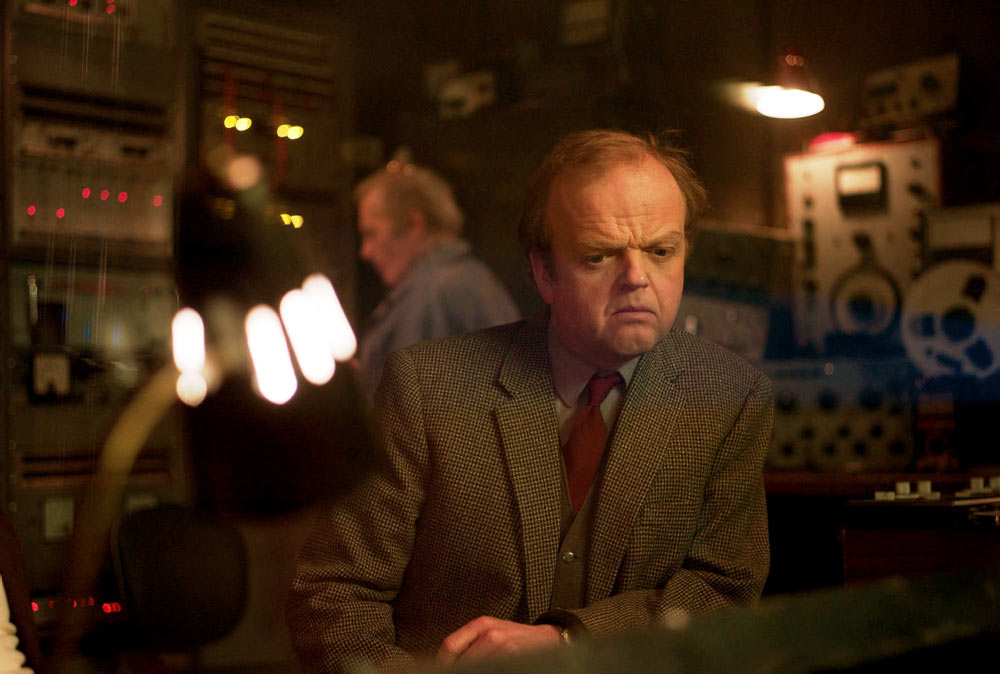
Finally, a Powell nominee that looks, feels and, most of all, sounds like an award winner.  Berberian Sound Studio, from Katalin Varga director Peter Strickland, stars Toby Jones as a sound technician recruited to work on a Suspiria-esque Italian horror film in the early 70s. More at home with gentle documentaries about the English countryside than graphic tales of undead witches, Jones soon finds his grip on reality loosening.

It’s difficult to describe the plot in any more detail: it’s essentially a journey into the protagonist’s fracturing psyche.  So while those seeking a traditional narrative may be left frustrated, anyone who wants to see the tools of cinema used to surprising and creative effect can expect a treat.  I was reminded of The Artist by the way sound is used to play with and confound audience expectations, while the sense of menace and disorientation has much in common with David Lynch (I was particularly put in mind of Inland Empire).

Spaghetti horrror buffs may well also be intrigued (it did cross my mind that the film might also turn up at FrightFest); it’s clear Strickland knows his Argento, and while some genre fans might be baffled by the closing scenes, I’ve seen Lucio Fulci films that made a lot less sense.

It’s one of the best films at the Festival, and one which clearly loves film – both as an artform and a physical object.  Highly recommended.

Edinburgh 2012 part III

Let’s start with some nominees for the Michael Powell Award. Life Just Is starts with several characters watching a film on TV. One comments: “That’s 90 minutes of my life I’ll never get back”. This is what is known in Film Studies circles as ‘asking for trouble’.
I won’t comment further on the script, as I left about half way through. I took no pleasure in doing so – getting a film made obviously entails a great deal of work, and I generally feel I should at least watch the end result properly before putting the boot in.  But this time I just couldn’t.
He film is a tale of middle youth angst, starring a bunch of twentysomethings. The opening scenes are among the most stilted I’ve seen in years; a group of people sitting awkwardly in a room that, it is painfully obvious, is not where they live in real life (it is absurdly tidy), delivering dialogue with lengthy pauses between each line. It feels like watching an early rehearsal of a fringe play.  Whatever effect director Alex Barrett was aiming for is missed by miles.
It’s not as though he’s lacking in visual sense, though his influences can be a bit obvious; there’s a nice shot that follows one character along a street before circling round in front of him. But this will do him little good if he can’t master shooting dialogue that sounds as though it’s being delivered by actual human beings.
I am something of a sucker for films set in Cuba (even more so than for films set in Edinburgh). You’re pretty much guaranteed stunning locations and a great soundtrack. So John Roberts’ Day of the Flowers, the story of two bickering sisters taking their father’s ashes back to Trinidad, was always going to score some easy points from me.
There’s plenty more to like in the film as well, starting with the cast – Eva Birthistle and Charity Wakefield as the leads, and Carlos Acosta as the inevitable local romantic interest (the excellent Bryan Dick is sadly left largely on the sidelines). Against that, the plot unfolds in rather predictable fashion. You know Birthistle’s determinedly self-reliant and perpetually right-on character will have her preconceptions challenged, and will learn to accept help from the right sources. You know that she and her more materialistic sibling will fall out before becoming closer; and you know that some family secrets will be unexpectedly revealed (though some of the details here were left a little vague).  It hits all the emotional beats in a fairly effective manner, but that’s not always enough. There are a lot of films in cinemas, and for a release to stand out it generally needs either a massive marketing budget, or to be very, very good.  Day of the Flowers is an entertaining watch,  but the screenplay needed a further polish to raise it above the ‘fine for TV’ level.
Much better is California Solo. Robert Carlyle stars as a former britpop star now living quietly in California, where he works on a farm. Haunted by guilt over the death of his brother, he drinks far too much. When he’s caught driving drunk, an old drugs possession charge leaves him facing deportation.
It’s no surprise that Carlyle is terrific. What’s less expected is the fine screenplay from director Marshall Lewy. Lachlan (Carlyle’s character) has clearly spent a fair chunk of his life acting like a bit of a shit, yet Carlyle gives him the charm and charisma to show why his friends stick with him.
Better yet,the screenplay allows Carlyle to gradually reveal the character without having to spell things out. It makes it’s points about the need to accept and face the past without resorting to easy sentiment, and is all the more moving for it. Highly recommended.
A very different kettle of squid is Grabbers, yet along with California Solo, it’s perhaps the most satisfying film I’ve seen at Edinburgh yet this year. What we have here is essentially the Irish Tremors. It’s not quite as good as Tremors – few films are – but it’s several cuts above your average monster movie.
Something nasty and hungryis emerging from the waters around a tiny Irish island. It drinks blood, bites off heads, lays eggs and thrives in water – and there’s a big storm on the way, which makes things all the tougher for alcoholic Garda cop Richard Coyle and his perky, by-the-book partner Ruth Bradley.
The film looks good, and has impressive creature effects.  The cast is strong – Russell Tovey delivers some top drawer drunk acting – and, most importantly, someone has paid attention to the script, which delivers plenty of laughs. You’re bound to get a chance to see this one, and hopefully in cinemas: it’s a dead cert for FrightFest, and deserves a decent release.

Edinburgh 2012 part II

Three days in to this year’s Edinburgh International Film Festival, and while I haven’t seen any major stinkers, there’s been nothing to blow me away either. Let’s start with the longest. Blood of My Blood is a three hour drama set in Lisbon, based around the travails of Maria (Rita Blanco) and her extended family. The themes are family loyalty and sacrifice, but the tools unfortunately include a plot reveal straight from the box of melodramatic cliches. Also, a climactic scene is overly unpleasant – that’s enough forced blow jobs for one year, Edinburgh, thanks all the same.

Lovely Molly is the latest from Eduardo Blair Witch Sanchez, and suffers from overfamiliarity. Not only does the use of video footage recall his debut (although this is not a found footage film), but plot elements recall recent releases such as The Silent House and The Pact.

Gretchen Lodge is very good as newlywed Molly, who moves with her husband Tim into her parents’ home. Pretty soon, things are going bump in the night and family skeletons are emerging from the closet. Is this an actual haunting, or is Molly going nuts?

The answer seemed pretty obvious to me, despite some attempts to imply a supernatural dimension – which Sanchez admitted in the Q&A were bumped up after early test screenings. Although that does give us one memorably eerie image at the close, it also means the story doesn’t completely satisfy at either level. An OK watch that doesn’t offer anything new, you can safely wait until this one’s on telly.

That’s also true of Flying Blind, a BBC production starring Helen McCrory as an aerospace engineer who starts a relationship with Algerian student – OR IS HE? – played by Najib Oudghiri. Though nicely played and good to look at (Bristolians can play spot the location), the central relationship feels like a dramatic construct rather than anything real. If the superior Page Eight last year couldn’t muster a cinema release, there’s no reason for this not to go straight to BBC 2.

Better things came with Life Without Principle, Johnny To’s crime thriller set against a global financial shitstorm. Various characters – among them a cop, a gangster, a bank saleswoman, and a bunch of financially strapped innocent bystanders – are involved in are affected by the murder of a loan shark. I’d bet my money on a Hollywood remake of this coming our way before long, so invest some time in the original.

Finally, one of my favourites to date. The best thing about festivals is sitting down for a film about which you no little and expect nothing, and being delighted by the result. That’s what happened with Flicker, a deadpan Swedish comedy centred around the struggling Unicom Telecommunications company.

Attempting to launch a new 4G network, but faced with a misguided advertising campaign and customer dissatisfaction and regular sabotage, the company also has staff who aren’t quite up to the challenge. Chief among them is sad sack Kenneth (Jacob Nordenson), whose recurring IT problems leave a crucial report incomplete, and Trod (Knell Bergqvist), the company head, who is heroically unaware of his own inadequacy.

Though we eventually realise the film is set in 2011, the design seems to have been pickled in the 70s. Almost everything at Unicom (including the cars, the decor, and Kenneth’s entire wardrobe) is in shades of brown. (Maybe bits of Sweden do look like this, but it seems unlikely.) Their attempts at promotional launches are no more up to date.

A number of plots intertwine, occasionally threatening to tip from somewhat black comedy to outright tragedy, while never quite doing so. Occasionally absurdist, with moments of outright slapstick, the film is quite a charmer. Lovely closing shot, too.

Edinburgh 2012: Day one

The Life and Times of Paul, the Psychic Octopus

Alexandre O Philippe’s documentary The People vs George Lucas, shown at Edinburgh a couple of years ago, was a hugely entertaining look at Star Wars fans’ love/hate relationship with their favourite films,and their creator. His latest also looks at how celebrity culture affects and inspires its followers, through the story of the cephalopod who enjoyed a stunning run of accurate predictions during the 2010 world cup.

Opening on a melancholy note with Paul’s funeral, the film then looks at his rise to fame, his effect on those around him, and the question of whether or not his predictions were anything more than a massive fluke. Many of those interviewed – Paul’s UK-based agent, for one – clearly have their tongues in their cheeks at least part of the time, but the film is careful to allow Paul, and the other animals who make brief appearances, to retain their dignity. It’s like a more flippant version of last year’s Project Nim. Even the psychics who claim to receive messages from the deceased octopus are not mocked (at least not openly; the viewer can draw their own conclusions). It’s a nice balancing act that results in an entertaining film that asks sensible questions about a silly subject; although the relatively brief running time is quite long enough.

7 Days in Havana

A portmanteau movie from directors including Benicio del Toro, Gaspar Noe and Laurent Cantet (among others) that comprises seven short films set in the titular Cuban city. That’s quite a few shorts, and I did feel that maybe 5 days in Havana would have allowed several of them valuable extra breathing space. As it is, the stories are on the slight side, starting with Josh Hutcherson as a young actor who has a brief encounter on s drunken night out. Emir Kusturica amusingly plays himself as a drunk, grudgingly accepting an award from the Havana Film Festival, but the most memorable and disturbing segment is Noe’s voodoo vignette. While as a full movie it may not totally satisfy, Havana itself – as always – looks, and sounds, beautiful.

Killer Joe

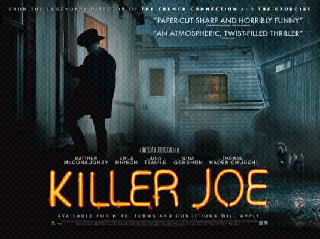
This year’s opening film is a lurid, violent, occasionally funny slice of melodrama from William Friedkin; though if I hadn’t known, I might have taken it for a lost work by Oliver Stone.

Matthew McConaughey is on great form in the title role, as a cop who moonlights as a hired killer. He’s employed by a spectacularly dumb white trash family for a plan masterminded by Chris (Emile Hirsch) to kill his mother for the insurance payout. As Joe normally demands payment up front, Chris agrees to put up his younger sister Dottie up as collateral. Dottie (Juno Temple) appears to be away with the fairies for much of the time, but to what extent is tough to say.

Obviously, the plan goes wrong, and it does so in a fairly OTT manner. I was unaware going in that the film is based on a play (by Tracey Letts) but it became obvious well before the end. It actually feels like something Quentin Tarantino trying to write like Tennessee Williams; the mix of explicit violence and black comedy is sometimes uncomfortable, and the characters never feel as though they have any existence beyond the stage.