Monthly Archives: June 2011

Edinburgh 2011 reviews continued

Albatross: Enjoyable coming of age yarn that plays a little like Tamara Drewe, though for my money it’s a lot more entertaining.  The middle aged writer this time is Sebastian Koch, still living off and haunted by the success of his debut novel a couple of decades previously.  The object of his desire is Emilia (Jessica Brown-Findlay), a free spirit, aspiring writer and new best friend to his daughter Beth (Felicity Jones). 

Emilia is a gift of a role for Brown-Findlay, who will deservedly get a lot more work from this film (I was trying to remember what I recognised her from – turned out to be an episode of Misfits, though she was also in Downton Abbey).  Koch and Jones are also strong, as is Julia Ormonds as Beth’s bitter mother.  It is perhaps a bit too tidily structured (it’s like, everyone in the film has an albatross round their neck, yeah?) but a very worthwhile watch nonetheless.

Rabies: This Israeli horror starts like many a torture porn flick: a young woman is caught in a trap in the woods, a young man is struggling to free her, a killer is on the prowl.  Once the rest of the characters turn up – two couples looking for a tennis club, a couple of cops – it becomes more of a black comedy. On those terms it works pretty well, though it does stretch credulity that so many stupid people could show up in the same remote spot in such a tight time period.  The film has some decent jumps among the running around in the woods, and a good punchline, but the high level of fuckwittery on display makes you want to throttle many of the characters. 

Troll Hunter: The hotly anticipated found footage comedy horror from Norway.  A trio of students are attempting to make a film about an apparent poacher: it’s not really spoiling things to say he turns out to be a troll hunter, secretly employed by the Norwegian authorities to manage the country’s troll population. 

My expectations for this were probably too high, and I suspect I’ll like it more on a second viewing.  First time round I felt the need for more scares among the comedy, and a subplot about one of the characters becoming ill ends up going nowhere.  But the basic concept is strong, and the trolls themselves are beautifully rendered, looking just like you imagined them in childhood. 

The Divide: There seem to be a quite a few apocalypses on screen at Edinburgh this year (apocalypti?), and this is the most depressing.  After someone – we never know who – drops a nuke on New York, a group of characters hole up in a bunker under their apartment building to wait for rescue, which doesn’t come.  Things get gradually worse and worse for them, and the luckless audience.  I can’t honestly recommend that anyone see this film, but if you want something that crushes all sense of hope and fills you with loathing and contempt for your fellow man, then this certainly does the job.

Finally, The Caller.  A slightly odd selection for the Festival – it’s not bad by any means, but I’m not clear what it’s doing here rather than the shelves of HMV in a box with ‘the stars of Twilight and True Blood’ plastered across it.

Rachel Lefevre moves into an old apartment after splitting from her violent husband, where she starts getting phone calls from a woman who thinks it’s 1977.  Our heroine decides it would be a good idea to encourage her to be less of a doormat, only to inadvertantly create a monster – a crazed murderer who who is able to bump off the people she cares about before she’s even met them. 

It reminded me of Asif Kapadia’s The Return, in that it’s a straight to DVD premise with greater stylistic aspirations.  Lefevre and her love interest Stephen Moyer are both good, but it’s one of those films that will work just as well on TV.
Edinburgh 2011 part II

Interestingly, the first two documentaries I’ve seen at Edinburgh this year have followed very similar plot arcs.  Both concern an individual who is feted from an early age for his unusual intellectual abilities. In both films, the subject becomes a media darling before his unpredictable and aggressive behaviour begins to drive his friends away. He becomes a lonely, tragic individual before a late partial redemption, thanks to old friends and supportive well-wishers, allows him to live out his days in a degree of comfort and security. Both tell their stories through a.mix of archive footage and interviews with people who knew and worked with the subject, who is now deceased.

Also, they’re both excellent.

The comparison does fall down in that genius chess player Bobby Fischer- subject of Bobby Fischer Against the World- was brought down by his own paranoia and madness, whereas Nim Chimsky- the primate whose life is explored in Project Nim – was exploited  from birth by humans whose motives he could not possibly understand. He was initially part of an experiment to study apes’ potential to learn  to communicate like humans, being raised in a family like human baby, and taught sign language. Later, as  he became too strong and unpredictable to control, he ended up in an animal experimentation lab.

A number of his teachers clearly feel a degree of guilt for the part they played in Nim’s unnatural life (though the project’s originator might benefit from a little more self awareness). Nim’s essential powerlessness makes his story the more emotionally affecting of the two, but both films are highly recommended.

Edinburgh 2011 reviews

The first couple of days of screenings here have been a mixed bag. John Michael Macdonald’s The Guard turned out to be a fine choice for opening film: a hugely entertaining crowd pleaser which sees In Bruges meet Lethal Weapon. The shared lineage with the former film is evident throughout; not only are the directors brothers,  there’s the presence of Brendan Gleeson, on top form with the hilariously sweary dialogue. Here, Gleeson’s deceptively undistinguished Garda officer is teamed with Don Cheadle’s FBI agent to track down  team of drug smugglers led by Liam Cunningham and Mark Strong.
The Argentine end of the world drama Phase 7 had it’s moments, but some odd shiftsin tone meant I couldn’t enjoy it as much as I would have liked.  As society collapses under the onslaught of a deadly virus, a young couple hole up in their apartment block while their neighbours take up arms against each other.  
The scenario is played mostly straight, but with occasional jarring lurches into black comedy and slapstick that do little more than diffuse tension.  Worse, the central couple are quite annoying –  he guy is petulant  and unreliable, while the woman spends most of her time complaining (often with some cause, but still).  I was also distracted by the score, which is a homage (or rip off, if you’re feeling less charitable) of John Carpenter’s back catalogue. I’ve seen worse, but it’s not a total success.
Much better is Tomboy, a tween variant on Boy’s Don’t Cry, from Water Lillies director Celine Sciamma. Lead character, a 10 year old girl called Laure, moves house and impulsively pretends to the local kids that she’s a boy. It’s very plausible at first – lead Zoe Heran is remarkable, and the film actually conceals her gender for the first 10 minutes – but the illusion proves harder and harder to maintain, and you’re soon dreading the inevitable. A moving, believable film with a  collection of superb child performances.
The Hungarian auteur Bela Tarr makes films for people who find the works of Ingmar Bergman to be on the frenetic side.   Turin Horse, which may apparently be his final work, is described in the programme this: “In Turin in 1889, the philosopher Fredrich Nietzsche stopped a cab driver from whipping his horse and promptly collapsed, spending hs remaining years in more or less demented silence.” Quite what this has to do with the events we seeon screen I’m unclear, though “demented silence” is certainly how the two main characters live. A man and his adult daughter living in an isolated house on a permanently windswept plain, we see then going about their daily routine: feeding the horse, cleaning, cooking (their diet consists of boiled potatoes and nothing else).
Gradually we become aware that something is wrong: a neighbour visits with warnings of doom, the horse become sick and refuses to eat.  Just what apocalyptic events are  unfolding we never learn: we simply observe the two people descend into silent, baffled despair.
Tarr – who has also programmed some vintage Hungarian cinema for this year’s EIFF – can only be described as an acquired taste. His work makes no concessions to those who enjoy such things as plot and dialogue. You have to be willing to immerse yourself in his bleak, black and white, doom-laden visions to get any kind of pleasure from this film; not everyone will be willing to make that kind of leap.

Some thoughts on the BBFC ban of Human Centipede 2: Full Sequence

So the BBFC have banned Human Centipede 2: Full Sequence.  It’s very rare for them to refuse a certificate outright – it’s usually a matter of a few cuts, often to achieve a lower certificate.  But this time it’s a flat no.  Nobody in the UK will be able to watch the film legally.  And my first thought was: Oh, thank fuck for that.
This disturbed me a bit, because I think of myself as being someone opposed to censorship of this nature.  Certification, sure, making it clear that some material isn’t suitable for children – don’t have a problem with that.  But telling adults that they aren’t grown up enough to watch a film, one that consists of a made up story performed by actors in the process of which nobody was hurt?  That’s just not on. 

My feeling was always that you’re either against censorship or you’re not.  It’s no good being against it until you run into something you personally find offensive; that’s easy.  It’s arguing for the right of people to watch (or read, or hear) material that turns your stomach that’s the challenge.  And I used to be able to do that; I’ve no desire to see I Spit On Your Grave, for example (either the original or the recent-ish remake) but I’m happy to accept the makers’ assurances that its not intended as porn for rape fantasists and allow it to be seen by consenting grown ups.  Years ago, I went to see Henry: Portrait of a Serial Killer partly because of the trouble it had getting a UK certificate.   More recently, I went to a screening of Last House on the Left at the ICA, aware that it might be my only chance to see it (it’s since been released uncut on DVD).  It was horrible, but given the subject matter it should be.
This was partly because my interest in film started forming at around the time when a fair few of the films I would have liked to see were banned.  I hadn’t really noticed the Video Nasties furore, which led to the passing of the 1984 Video Recordings Act; I was just a couple of years too young to take an interest.  I only really found out about it a few years later, when I picked up a copy of Martin Barker’s book The Video Nasties: Freedom and Censorship in the Media.  This was how I discovered the reasons why I wasn’t allowed to see (among others) The Texas Chain Saw Massacre or The Exorcist. 

I was particularly suspicious because of the sort of people who were making these decisions for me; they seemed to be ghastly Bible-bashers of the James Anderton variety, or hysterical ‘think of the children’ types.  None of them seemed to speak for me, or have any grasp of the kind of films I was interested in.
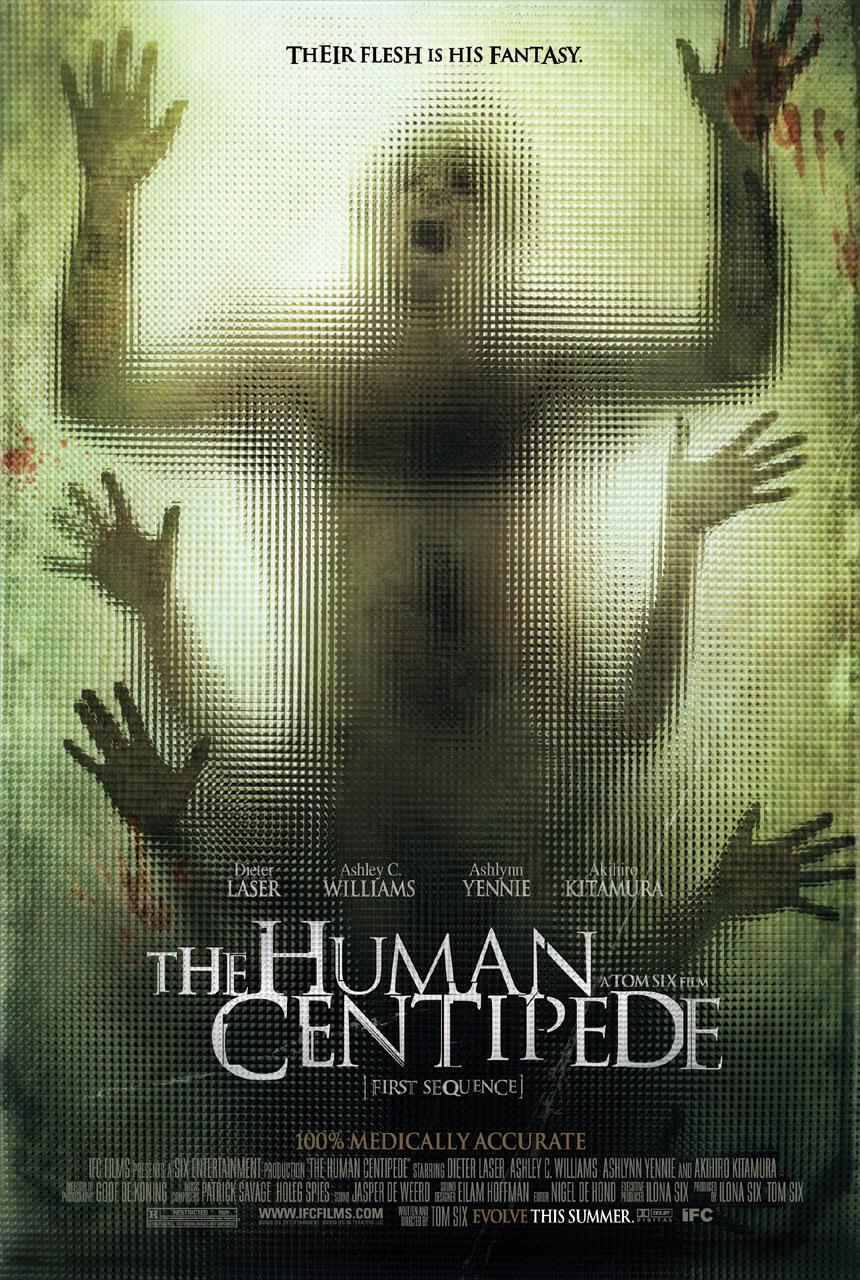
But Human Centipede 2 is something else.  It’s partly because I’m getting older; unrelenting misery and nihilism just doesn’t seem as clever to me as it did when I was a sixth former.  Call me a big old softy, but I like a happy ending, or at least a glimmer of hope (which is why I still enjoy the Saw films: Jigsaw’s trying to help those people, not kill them!).   I found Human Centipede 1 to be a thoroughly repugnant film, one that depressed me just by existing.  Yet it’s apparently a picnic compared to the follow up, which the BBFC press release tells us “Unlike the first film, the sequel presents graphic images of sexual violence, forced defecation, and mutilation, and the viewer is invited to witness events from the perspective of the protagonist. Whereas in the first film the ‘centipede’ idea is presented as a revolting medical experiment, with the focus on whether the victims will be able to escape, this sequel presents the ‘centipede’ idea as the object of the protagonist’s depraved sexual fantasy.
I certainly won’t lose any sleep from being denied the opportunity to see that.  But looking at the extended plot description, I can’t help wondering if there isn’t something more going on here than the desire to shock.  The BBFC release tells us the story is about “a man who becomes sexually obsessed with a DVD recording of the first film and who imagines putting the ‘centipede’ idea into practice… [there is] a scene early in the film in which he masturbates whilst he watches a DVD of the original Human Centipede film, with sandpaper wrapped around his penis, and a sequence later in the film in which he becomes aroused at the sight of the members of the ‘centipede’ being forced to defecate into one another’s mouths, culminating in sight of the man wrapping barbed wire around his penis and raping the woman at the rear of the ‘centipede’…”
What’s interesting is that the first film is here presented as a fictional work, and the villain is one of its viewers.  It’s worth asking what director Tom Six is up to.  Is he simply looking for a way to outdo the first film, or is he deliberately asking viewers to identify with his lead character?  If so – if he has switched to making his torturer into the viewer’s point of identification, something you couldn’t say of the first film – is he implicating the people who watched and enjoyed his previous work? 

From this perspective, Human Centipede 2 sounds closer to something like Michael Haneke’s Funny Games than anything else.  Maybe he’s telling us that anyone who enjoyed the first film must be sick in the head.   In that case, perhaps he’d agree with the BBFC’s ban. 

The public mood changes over the years; many of the formerly banned video nasties have re-emerged uncut on DVD.  Some can still shock, but in many cases you would wonder what all the fuss was about.  Maybe the same thing will happen to Human Centipede 2; it’s hard to say, as I’m not allowed to see it.  Perhaps I’d better keep an eye out for downloadable versions.  That, or just shrug it off and accept that I’ve started to turn into a Tory.