
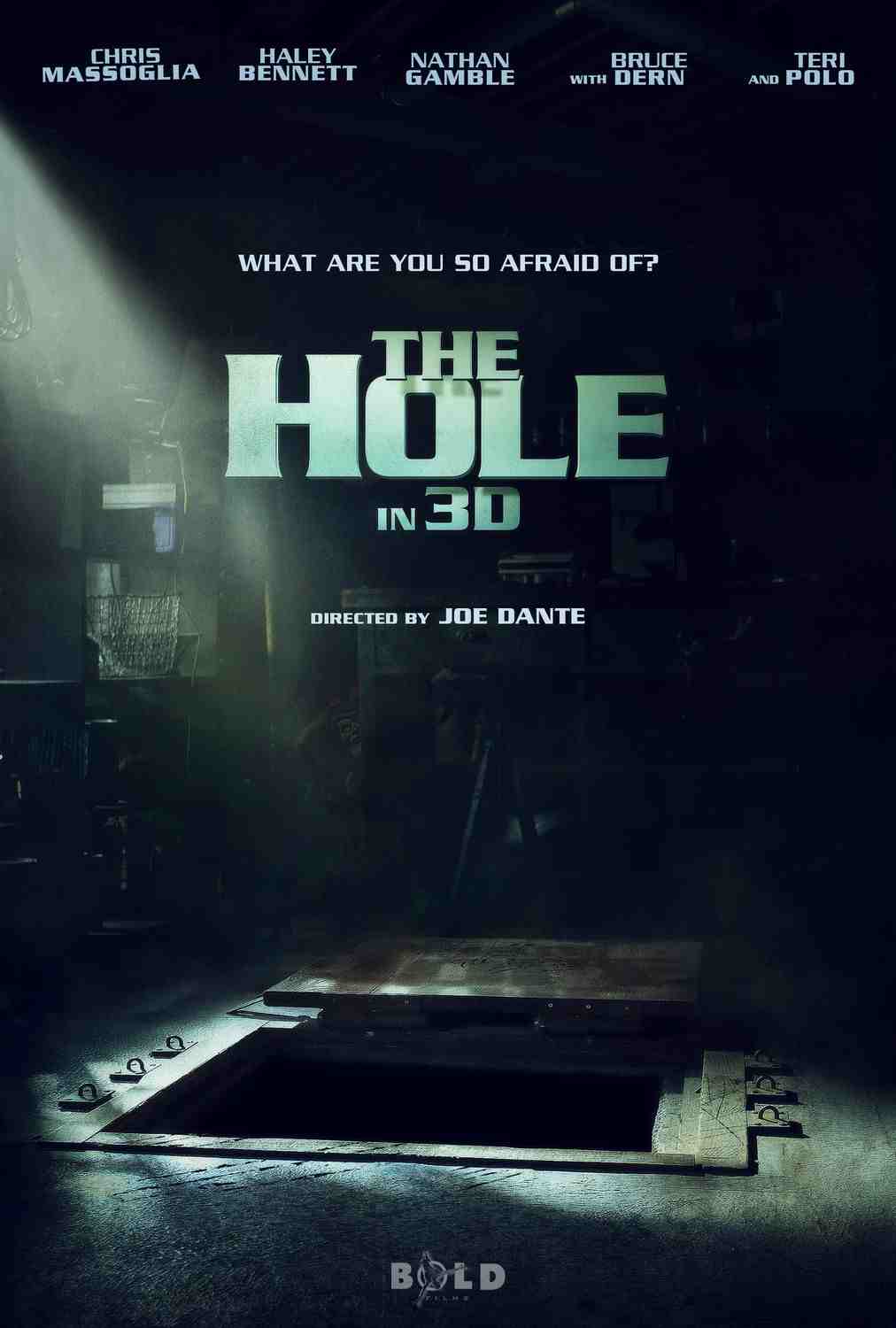
 Here’s something I’ve been anticipating ever since seeing director Joe Dante’s talk at the Edinburgh Film Festival last year (I got my photo taken with him afterwards). The Hole is a pleasingly old fashioned horror(ish) film for kids – and by old fashioned, I mean it’s reminiscent of 80s favourites like Dante’s own Gremlins, Fred Dekker’s The Monster Squad and the TV series Eerie, Indiana. There’s even a Dick Miller cameo.
Dane (Chris Massoglia), his mom and his kid brother (Nathan Gamble) move into a new suburban home, where the kids – along with Julie (Hayley Bennett), the hot girl next door – find a mysterious, heavily padlocked trap door in the basement. Naturally, they open it, to find an apparently bottomless hole. It seems to be empty, but before long some of their greatest fears are getting out, and are coming to get them…
The scares are strictly 12A-level. There’s a fair bit of creepy atmosphere-building at first, as odd things start to happen; though only those who share Lucas’s fear of clowns will be disturbed by his scenes, we also get a little ghost girl as disturbing as anything from the J-horror pantheon. (It’s very hard for a scary film to go wrong with little dead girls in my book.) Dane’s nightmare (of his violent father, currently in prison) is a little underwhelming by comparison, and leads to the climax being the film’s weak point. That’s unavoidable, given the film’s message about facing your fears – the threat is inevitably less scary once you look it in the eye than when it’s lurking in the dark. So although Hayley theorises that it’s a bottomless pit to Hell (quite correctly adding, “and that’s really cool,”), The Hole doesn’t go anywhere as nasty as that. I wouldn’t have minded a few more shocks, but that’s being selfish – I certainly wouldn’t wish to keep this film from the young audience it’s aimed at.
Dante also enjoys himself with the 3D, and wants to make sure the audience does too. A fan of the format from way back when, he has no qualms about throwing in every attention-grabbing coming-out-of-the-screen moment he can come up with. The plot lends itself easily to plenty of shots of people looking into, and dropping stuff into, the bottomless pit; rather charmingly, there’s even a shot of a kid on the bed, repeatedly tossing a baseball up toward the camera. It’s like Friday the 13th part III hadn’t happened. While the best bits will hold up fine in 2D, this is a pleasing example of form and content complementing each other.
I hope there’s space in cinemas for The Hole to settle, between the likes of Despicable Me and tween stuff like Twilight. It’s a well-crafted crowdpleaser which will entertain anyone with fond memories of the 80s fantasy/adventure films that generally had Dante and/or Steven Spielberg’s names on. And, if they’ve any taste, it’ll please their kids as well.
 Gareth Negus